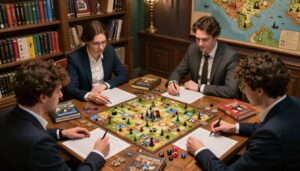
AI tools are changing RPG world-building most noticeably at the rough-draft stage. They can turn a premise into lists of factions, locations, conflicts, and adventure hooks in seconds. They can also reformat scattered notes, suggest connections, and produce alternate versions of material that is not working.
That speed is useful, but it is easy to mistake volume for depth. Language models produce plausible text rather than verified setting facts. They can contradict established lore, invent rules, flatten distinctive cultures into familiar fantasy tropes, and present mistakes with complete confidence.
The practical question is therefore not whether an AI tool can create a world. It is where the tool fits within a creator-led process—and where human judgment remains essential.
What AI Tools Actually Change
They make divergent brainstorming faster
A conventional random table usually combines a fixed collection of entries. A language model can respond to narrower creative constraints: a city’s climate, political structure, religious taboos, available technology, and intended campaign tone.
That makes it useful when a generic result will not do. Instead of requesting “a fantasy city,” a creator can ask for six conflicts in a submerged city where breathable air is controlled by one institution and surface trade is illegal.
The chief benefit is not that every result will be good. It is that several directions can be compared quickly. The creator still decides which idea belongs in the setting, rewrites it in the setting’s voice, and discards the rest.
They can transform existing notes
World-building often involves converting information from one form into another. A page of historical notes may need to become a timeline. A faction description may need a GM-facing summary, three rumors, and a player-safe handout.
Language models are often more dependable at this kind of transformation than at inventing canon from nothing. If the source material is supplied clearly, a tool can:
- Summarize a long location entry for session use.
- Extract named characters, dates, and unresolved plot threads.
- Turn prose into a table or checklist.
- Rewrite a description for a different tone or reading level.
- Separate public knowledge from secret GM information.
- Suggest questions that the existing notes have not answered.
Every transformed document still needs review. Summaries can omit qualifications, merge separate facts, or introduce details that were never present in the source.
They reduce some forms of session preparation
AI-assisted drafting can help populate the edges of a prepared setting: minor NPC motivations, local customs, shop inventories, travel complications, rumors, or sensory details for a location.
This is most useful when the GM provides boundaries. A generated encounter is more likely to fit if the prompt specifies the party’s situation, the region’s dangers, the desired difficulty, and what must not appear.
Rules content requires greater caution. A model may mix game editions, use obsolete terminology, miscalculate statistics, or reproduce the shape of a familiar stat block without making it mechanically sound. Treat generated mechanics as an unverified draft and check them against the rules actually being used.
They broaden access to visual concepting
Image tools can help establish mood, architecture, clothing, landscape, or the broad appearance of an NPC. These images may be useful as private references or temporary table handouts.
They are less reliable for functional maps. Labels, scale, room connections, repeated symbols, and exact geography are common failure points. A visually impressive city plan may be unusable as a navigable location. For tactical or publication-ready maps, expect to redraw the result or use dedicated mapping software.
Visual tools also introduce questions about licensing, provenance, artistic consent, and stylistic imitation. Those concerns become especially important when artwork will be published rather than used privately at a table.
The Central Limitation: A Model Is Not Your Canon
A language model should not be trusted as the sole record of a setting. It does not remember a campaign in the same way a human participant does, and conversational memory is not a dependable substitute for organized notes.
Some platforms use lorebooks, project files, or retrieval systems to supply relevant information when responding. Those features can improve consistency, but they do not guarantee it. If the underlying notes are incomplete, stale, or contradictory, the output will reflect those problems.
Maintain a separate source of truth containing approved setting facts. This can be a dedicated world-building platform, a wiki, an Obsidian vault, or an organized collection of documents. Distinguish among:
- Canon: facts established as true in the setting.
- Draft material: ideas being developed but not yet approved.
- Rumors: claims that exist in the fiction but may be false.
- Open questions: details intentionally left unresolved.
- Discarded ideas: material that should not reappear accidentally.
This separation is particularly valuable when generated suggestions sound authoritative. An attractive paragraph is not canon until the creator chooses to make it canon.
How to Evaluate a World-Building Tool
| Criterion | What to examine | Common limitation |
|---|---|---|
| Lore handling | Whether the tool can store, retrieve, link, and update established facts. | A lorebook may surface relevant notes without detecting contradictions. |
| Editorial control | How easily output can be revised, rejected, reorganized, and exported. | Fast creation is less valuable if material becomes difficult to move elsewhere. |
| Prompt control | Support for tone, constraints, exclusions, templates, and reusable instructions. | More settings can create a steeper learning curve. |
| Rules support | Whether mechanics match the intended system and edition. | Plausible-looking statistics may still be illegal or poorly balanced. |
| Visual features | Portraits, concept art, diagrams, or map-related functions. | Visual consistency and exact spatial relationships remain difficult. |
| Privacy | How prompts, uploads, campaign notes, and account data are handled. | Terms may differ by product, account type, and selected settings. |
| Long-term access | Export options, backups, readable file formats, and dependence on a subscription. | A closed platform can make migration difficult. |
| Cost | Usage limits, feature restrictions, and whether regular use justifies the expense. | Plans and limits change, so old comparisons become unreliable quickly. |
Which Tools Fit Which Jobs?
No single product covers brainstorming, campaign organization, prose editing, visual development, and rules validation equally well. The following tools serve different parts of the process.
World Anvil: structured setting documentation
World Anvil is primarily a world-building and campaign-management platform. Its templates and interconnected articles suit creators who want an encyclopedic setting reference rather than a collection of isolated chat responses.
It is a strong fit for settings with extensive histories, locations, organizations, family relationships, and terminology. A GM can maintain detailed internal material while preparing selected information for players.
Its breadth is also the main tradeoff. A creator planning a short adventure may find the structure excessive, and learning how to organize a large world takes time. AI-assisted features should be treated as drafting aids within that structure, not as automatic continuity control.
Best for: lore-heavy campaigns and creators willing to maintain a formal setting database.
Less suitable for: quick one-shots or anyone who wants an immediate, minimal workspace.
Friends & Fables: AI-assisted TTRPG creation and play
Friends & Fables is oriented toward tabletop role-playing rather than general fiction. It brings generated characters, locations, creatures, items, and other campaign elements into a game-focused environment.
This makes it more relevant to a GM who wants world information connected to active play than to an author seeking a publication-oriented setting encyclopedia. Before committing a large project, examine how well its supported game structures, editing tools, and export options match the campaign.
Best for: GMs who want generated campaign elements within a TTRPG-focused workspace.
Less suitable for: creators who need complete control over document structure or publication files.
Sudowrite: prose development
Sudowrite is designed around fiction writing. Features such as rewriting, description assistance, brainstorming, and its Story Bible can help develop scenes and maintain relevant character or setting information while drafting.
Its natural role in RPG creation is improving boxed text, location descriptions, character moments, and setting fiction. It is not a campaign database or rules engine, and polished language should not be confused with mechanical accuracy.
Best for: creators focused on atmosphere, narrative voice, and setting fiction.
Less suitable for: encounter design, stat-block validation, or comprehensive campaign management.
NovelAI: customizable text and visual experimentation
NovelAI combines storytelling tools with a Lorebook and image features. Its customization options suit creators who are prepared to spend time adjusting context, instructions, and output behavior.
The Lorebook can supply recurring setting information, while the visual features can support private concept development. The tradeoff is that effective configuration requires more experimentation than a simple prompt-and-response interface.
Best for: creators who value customization and want text and visual concepting in one service.
Less suitable for: users seeking a tightly structured campaign wiki or verified game mechanics.
ChatGPT and Claude: flexible generalists
General-purpose assistants such as ChatGPT and Claude can brainstorm factions, reorganize notes, draft handouts, compare alternatives, and identify questions about a developing setting. Their flexibility makes them useful for tasks that do not justify a specialized platform.
They should not be treated as self-maintaining campaign databases. Project and memory features vary, and important facts can still be omitted or contradicted. A separate canon document remains necessary for any substantial setting.
Best for: varied brainstorming, note transformation, critique, and early development.
Less suitable for: creators who expect the conversation itself to preserve a complex world reliably.
Features, usage limits, privacy controls, and pricing can change. Evaluate the current product documentation before moving an important campaign or unpublished manuscript into any platform.
A Reliable AI-Assisted World-Building Workflow
1. Write a creative brief before requesting ideas
Define the setting’s premise, themes, tone, technology, supernatural rules, and boundaries. Include elements that must not appear. This gives the tool a meaningful design space instead of asking it to imitate generic fantasy.
A concise brief might establish that a submerged city survives inside three air domes, surface trade is forbidden, divine magic is rare, and the campaign concerns civic pressure rather than an ancient awakening.
2. Ask for options, not a final answer
Request several distinct approaches and require each to explain its consequences. This makes comparison easier and reduces the temptation to accept the first plausible paragraph.
Propose six political conflicts for a submerged city divided among three air domes. The temple controls the repair crews, but it cannot legally govern. Surface trade is forbidden. For each conflict, identify the factions involved, the visible consequence for ordinary residents, one hidden pressure, and an adventure hook. Do not introduce a lost prophecy, a chosen hero, or an ancient evil.
The exclusions matter. They prevent the response from falling back on familiar plot devices that do not fit the intended campaign.
3. Mark supplied facts and new proposals separately
Tell the tool not to blur canon with invention. A useful instruction is to label every unsupported addition as a proposal and to state when the notes do not contain enough information.
This is especially important when developing histories. If a model fills every gap automatically, uncertainty disappears and accidental inventions can become difficult to distinguish from the creator’s original decisions.
4. Select, combine, and rewrite
Generated material is raw material. Choose the useful parts, remove repetition, test the logic, and rewrite the result in the setting’s established voice.
Ask practical questions during this pass:
- Who benefits from this institution?
- Who pays its costs?
- How does it affect daily life?
- What can player characters change?
- Does it duplicate another faction or conflict?
- Is it based on a cultural stereotype?
- Does it support the campaign’s themes?
5. Run a contradiction check
A model can help compare a draft against supplied canon, but ask it to identify conflicts before suggesting repairs. Otherwise, it may quietly rewrite established facts to make the new passage fit.
Canon states that hereditary office was abolished forty years ago, the temple maintains the air domes, and untreated iron corrodes within a day. Review the draft and list every direct contradiction, unsupported assumption, and practical consequence it ignores. Do not rewrite the draft.
Review the reported problems manually. The tool may miss indirect conflicts or flag intentional mysteries as errors.
6. Validate mechanics separately
Check every creature, spell, item, difficulty, and encounter against the correct rules. Confirm action economy, damage, defenses, terminology, and expected party resources.
For published material, also verify that rules text is original or used under the appropriate license. A model cannot determine that a passage is safe to publish merely because it produced the wording.
7. Update the canon record
Once a draft is approved, add the final facts to the source of truth. Record what players know, what remains secret, and what changed during play. Do not rely on the original conversation to preserve those decisions.
Using These Tools at the Table
Most of their value appears before and after a session rather than during one.
Before play: prepare concise NPC cards, rumors, location details, likely complications, and alternate clues. Review everything before it reaches the players.
During play: use approved notes first. Live prompting can interrupt pacing and may return a contradiction at the worst moment. If a generated detail is adopted during improvisation, record it immediately so it can become part of the campaign history.
After play: a tool can help turn rough notes into a session summary or extract unresolved threads. Check names, decisions, and chronology against the original notes before sharing the summary.
Do not upload private player information, confidential messages, or unpublished commercial material without understanding how the service handles that data.
Creative and Ethical Limits
Generic output can dilute a setting
Models tend to reproduce common patterns: secret cults, forgotten gods, rigid elemental nations, vaguely medieval economies, and factions defined by a single trait. Specific constraints help, but strong editing is still required to produce a setting with a recognizable identity.
Bias can appear in cultures and characters
Generated descriptions may associate physical traits, accents, disability, class, or real-world cultural influences with moral qualities. Review cultures as societies containing disagreement, change, and internal diversity rather than as monolithic templates.
Commercial rights should not be assumed
Terms differ among services, and the legal treatment of generated material continues to develop. For publication, retain records of source material, licenses, substantial human revisions, and commissioned contributions. Avoid prompts that request imitation of a living artist or author.
The group should know how the tools are being used
A GM does not need to narrate every part of the preparation process, but table expectations matter. Players may object to generated portraits, uploaded session transcripts, synthetic character voices, or the use of their writing as input. Discuss uses that affect player data or the shared creative experience.
The Most Useful Role for AI in World-Building
AI tools are most effective as fast but unreliable assistants. They can widen the field of possibilities, transform notes into useful formats, and reduce repetitive preparation. They cannot decide what a setting means, which details deserve emphasis, or whether a world will produce satisfying choices at the table.
A sound workflow keeps the creator in charge: establish constraints, request alternatives, verify the result, rewrite it, validate the mechanics, and maintain an independent canon record.
The result is not effortless world-building. It is a shift in effort—from producing every rough draft manually to selecting, testing, connecting, and refining ideas. For RPG creators, that editorial work is where a collection of generated details becomes a world worth playing in.

Ravenous RPG Editorial Team covers tabletop role-playing games, Game Master tools, player guides, campaign design, character building, and RPG system analysis. Articles are edited for clarity, practical usefulness, and accuracy, and are updated when corrections or material changes are needed.