
Choosing an RPG class is easier when the decision starts with how you want to play rather than which class name sounds strongest. The right choice is not necessarily the class with the largest weapon, longest spell list, or most impressive late-game feature. It is the one whose routine decisions remain enjoyable from session to session.
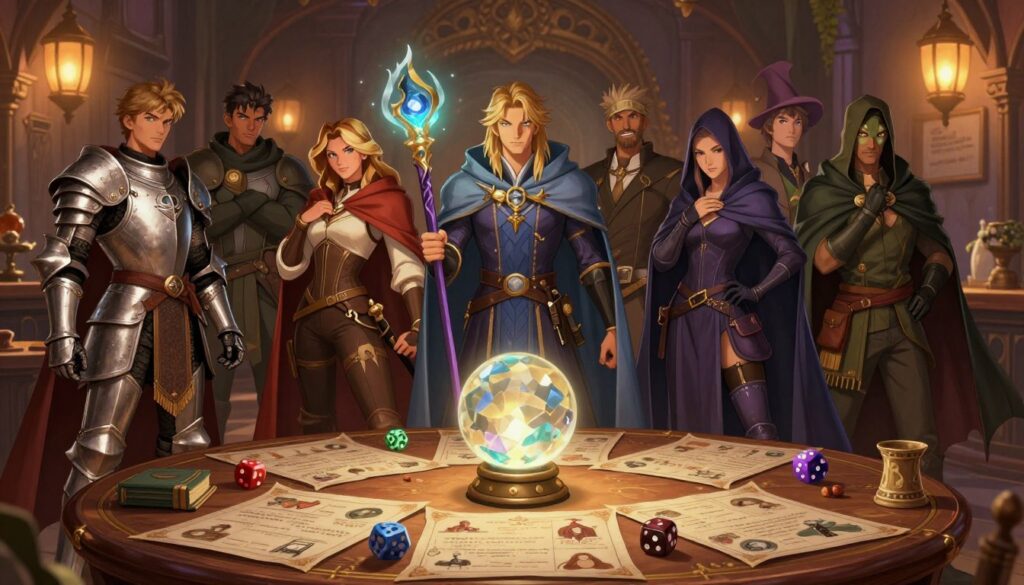
A class usually determines several things at once: what your character can do, how complicated those abilities are to manage, what the character contributes to a group, and which fantasy the rules are designed to support. A heavily armored guardian, a cautious scout, and a versatile spellcaster may all be effective, but they produce very different experiences at the table.
This guide provides a practical way to compare those experiences. The examples draw from familiar fantasy classes such as Fighter, Rogue, Cleric, Wizard, Bard, Druid, Ranger, Barbarian, and Paladin, but the decision criteria apply more broadly. They can also help with science-fiction professions, superhero power sets, MMO roles, and classless RPGs that ask players to assemble abilities individually.
What an RPG Class Actually Determines
A character class is a package of rules and themes. Depending on the game, it may determine combat abilities, equipment, skills, resource systems, magical powers, advancement options, or social standing in the setting.
Class names can be misleading when considered without their rules. A Fighter might be a defensive guardian in one game, an aggressive weapon specialist in another, or a flexible foundation that can develop in several directions. A Cleric may be an exceptional healer, but it could instead focus on armor, investigation, battlefield control, or destructive magic. A Rogue might be an assassin, a scout, a diplomat, or a problem-solving skill specialist.
Before choosing, separate four parts of the class:
- Mechanical role: What does the class usually do during play?
- Complexity: How many abilities, exceptions, and resources must its player track?
- Fictional identity: What kind of person does the class represent in the setting?
- Advancement path: Does it become more specialized, more versatile, or simply stronger?
A class is a promising choice when most of those elements appeal to you. If you love the image of a scholarly magician but dislike selecting spells and managing limited magical resources, the class fantasy may fit while the mechanics do not. That mismatch is worth noticing before the campaign begins.
Check the Game and Campaign Before Comparing Classes
There is no universal definition of what each class does. Even closely related fantasy RPGs assign different abilities and responsibilities to familiar names. The first step is therefore to examine the actual game being played rather than relying on expectations from another system.
Ask what the campaign emphasizes
A combat-focused dungeon expedition rewards different abilities than a campaign about court politics, wilderness exploration, criminal investigation, or magical academia. A heavily specialized combatant may dominate one campaign and struggle to find meaningful decisions in another.
Ask the game master or organizer a few direct questions:
- Will the campaign emphasize combat, exploration, social conflict, investigation, or a mixture?
- Are characters expected to begin as capable heroes, fragile novices, or something in between?
- How often are characters likely to rest and recover resources?
- Will equipment, ammunition, spell components, or encumbrance matter?
- Are any classes, subclasses, ancestries, or optional rules unavailable?
- Does the setting change how a class is treated in the fiction?
These questions reveal whether a class will have opportunities to use its defining abilities. For example, a wilderness specialist deserves clarification if most of the campaign takes place within one city. The concept may still work, but the player and game master should agree on how its expertise will remain relevant.
Identify the rules commitment
Some groups use only a core rulebook. Others permit several supplements, optional subsystems, or extensive character customization. Confirm which material is allowed before planning a build around a feature that may not be part of the campaign.
Edition also matters. Classes with the same name can change substantially between editions of a game. Advice about a particular Fighter, Bard, or Ranger is only useful if it applies to the rules at the table.
Consider campaign length
A class that develops slowly may be satisfying in a long campaign but disappointing in a short adventure. Conversely, an intricate advancement plan may never come together if the game covers only a few sessions.
When the expected length is uncertain, favor a character whose starting abilities already express the central concept. A prospective spellblade should be able to combine weapons and magic reasonably early, rather than waiting for a distant feature that the campaign may never reach.
Discover Your Playstyle
“Playstyle” covers more than a preferred combat role. It includes how much preparation you enjoy, how you respond to uncertainty, whether you seek the spotlight, and what kinds of decisions hold your attention.
Think about the choices you want to make repeatedly. A spectacular ability used once in a campaign matters less than the class’s ordinary turn, scene, or problem-solving routine.
| Preference | Look for | Approach cautiously |
|---|---|---|
| Direct, dependable actions | Clear attacks, durable defenses, passive bonuses, limited resources | Large spell lists and abilities with many conditional effects |
| Planning and preparation | Prepared spells, equipment choices, deployable abilities, tactical positioning | Classes built mainly around immediate reactions or repeated attacks |
| Adapting in the moment | Flexible powers, broad skills, movement options, reusable tricks | Highly specialized builds that depend on one setup |
| Helping other players succeed | Healing, protection, buffs, enemy control, coordinated attacks | Isolated abilities that contribute only personal damage |
| Independent action | Mobility, self-healing, stealth, broad competence | Characters dependent on allies for protection or setup |
| High-risk, dramatic turns | Burst damage, limited-use powers, dangerous positioning | Steady defensive classes with predictable output |
| Consistent performance | Reliable attacks, strong defenses, renewable resources | Classes that swing between spectacular success and limited options |
| Influencing the story outside combat | Social skills, investigation, contacts, utility magic, exploration tools | Classes whose rules focus almost entirely on fighting |
How much complexity do you want?
Complexity is not the same as power. A complicated class may offer more choices without being stronger, while a straightforward class can remain tactically important throughout a campaign.
If you want to learn the game gradually, look for a class with a clear default action and a small number of distinctive alternatives. This leaves room to pay attention to the situation, the other players, and the core rules.
If you enjoy system mastery, a class with prepared abilities, interacting resources, summons, transformations, or a broad spell list may be more engaging. The tradeoff is additional preparation and a greater chance of slowing play while reviewing options.
Do you prefer preparation or improvisation?
Preparation-oriented classes reward knowing what is coming. They may choose spells at the start of the day, purchase specialized equipment, study enemies, or arrange favorable terrain. They can feel brilliant when the plan works, but restrictive when circumstances change.
Improvisational classes tend to have smaller, more flexible toolkits. Their abilities may be usable in many situations without extensive advance planning. They are often easier to operate under pressure, although they may have fewer specialized answers.
How much risk feels enjoyable?
Some players enjoy placing a fragile character in danger to secure a decisive result. Others would rather remain dependable and difficult to disable. Neither preference is more skilled or more heroic.
Look at where the class must stand, how it escapes danger, and what happens when its main plan fails. A melee attacker may deliver exceptional damage but spend more time exposed to enemy attacks. A distant spellcaster may be safer until opponents close the gap or disrupt concentration. A defensive character may survive reliably but have fewer dramatic offensive turns.
What kind of spotlight do you want?
Spotlight is not limited to dealing the final blow. A character can become central by negotiating with an antagonist, discovering a hidden route, protecting an ally, identifying a magical effect, or changing the battlefield.
If you enjoy speaking for the group, consider classes supported by social skills, contacts, authority, or appropriate magic. If you prefer contributing without leading conversations, look for abilities that provide information, protection, or tactical support without making your character the party spokesperson.
Use Roles as a Map, Not a Rule
Online RPG discussions often sort characters into Tank, Healer, Damage Dealer, and Support. These labels are useful shorthand, particularly in games with formal team roles, but they do not describe every tabletop RPG accurately.
Many tabletop systems do not require a dedicated healer. Some do not have mechanics that let a “tank” force enemies to attack them. Others make scouting, investigation, negotiation, or resource management as important as combat. A party can also compensate for a missing role by changing tactics.
A broader role map is usually more useful:
| Role | Main contribution | Common class examples | Important limitation |
|---|---|---|---|
| Defender or front-liner | Occupies dangerous positions, protects allies, and restricts enemy movement | Fighter, Paladin, Barbarian | Durability alone does not make enemies engage the character |
| Damage dealer | Removes threats through burst, sustained, or area damage | Rogue, Ranger, Fighter, Wizard, Sorcerer | High output may depend on positioning, resources, or allied setup |
| Healer or protector | Restores allies, prevents harm, removes conditions, or provides temporary defenses | Cleric, Druid, Bard, Paladin | Reactive healing can consume turns without addressing the source of danger |
| Controller or support | Changes positioning, limits enemies, and improves allied actions | Wizard, Bard, Druid, Cleric | Impact may be less obvious than direct damage and can depend on teamwork |
| Scout or skill specialist | Finds information, bypasses obstacles, handles traps, and infiltrates locations | Rogue, Ranger, Bard | Specialties matter only when the campaign presents relevant challenges |
| Face or social specialist | Negotiates, deceives, gathers rumors, and manages relationships | Bard, Rogue, Paladin, Sorcerer | Social authority depends on the rules, setting, and group’s approach to dialogue |
Most classes cover more than one row. The goal is not to assign every character a fixed job, but to identify which contributions you would enjoy making most often.
Choosing a Defensive or Front-Line Class
A defensive character is for players who enjoy controlling space, absorbing pressure, and creating safer opportunities for others. The satisfying decisions usually involve positioning: which enemy to engage, which route to block, and when to retreat or protect an ally.
Check whether the game gives the class actual protective tools. High armor and many hit points help the character survive, but they do not automatically protect anyone else. Useful defender mechanics may include reactions against enemies who attack allies, movement restrictions, forced movement, interception abilities, challenges, marks, or zones that are difficult to cross.
Fighter
Fighters are often reliable weapon specialists, but their exact role varies widely. A shield-bearing Fighter with control abilities may defend effectively, while an archer or two-handed weapon specialist may function primarily as a damage dealer.
Choose a Fighter if you want martial competence, a clear connection to equipment, and a concept that can often be customized through fighting style or subclass. Do not assume the class will be mechanically simple; tactical Fighter builds can involve several reactions, maneuvers, and situational choices.
Barbarian
Barbarians commonly combine aggression with exceptional durability. They suit players who want to enter dangerous positions and remain effective while under attack.
The limitation is that toughness does not always equal control. A Barbarian may survive enemy attention without having a reliable way to keep enemies away from vulnerable allies. Examine mobility, grappling, intimidation, or other control options if protection is your main goal.
Paladin
Paladins often combine armor, offense, protective features, limited healing, and a strong narrative commitment. They are attractive to players who want to stand near the front while still supporting the group.
They are not ideal for everyone. Their abilities may draw from several resource pools, and their oath, code, order, or religious position may create roleplaying obligations. Clarify how those commitments work in the campaign rather than assuming they exist only as decoration.
Who should avoid this role?
A front-line class may frustrate players who dislike tracking enemy movement, accepting frequent attacks, or spending turns protecting others instead of pursuing personal objectives. It can also be uncomfortable for someone who wants to avoid being treated as the group’s automatic leader. Standing in front does not require making every strategic or social decision, so groups should not conflate those responsibilities.
Choosing a Healer, Protector, or Support Class
Support-oriented play is about changing what the whole party can accomplish. Healing is one form of support, but prevention, mobility, information, and enemy control can be equally important.
This role rewards attention to other characters. A support player needs to understand who is threatened, whose abilities could benefit from assistance, and whether a limited resource is worth using now.
Cleric
Clerics are frequently associated with healing, but that does not mean every Cleric must serve as a dedicated medic. Depending on the game and build, a Cleric might fight in armor, weaken supernatural enemies, investigate religious mysteries, protect allies, or use destructive magic.
Choose a Cleric if divine power, faith, duty, or a relationship with a religious institution interests you. Before committing, ask how religion functions in the setting and whether the character must follow formal restrictions.
Bard
Bards often combine social competence, broad skills, magic, and abilities that improve allied actions. They are well suited to players who want to move between conversations, exploration, and combat rather than specialize in one area.
That breadth can be demanding. A Bard may need to choose between helping an ally, controlling an enemy, casting a utility spell, or taking direct action. The class also does not have to be played as a comic musician. Its performance theme can represent an orator, storyteller, diplomat, historian, dancer, or other setting-appropriate artist if the rules permit.
Druid
Druids commonly offer healing, terrain control, utility magic, summoning, or transformation. They appeal to players who want a broad toolkit tied to nature, spirits, or the wilderness.
Their versatility can create a substantial rules burden. Transformations and summoned creatures may introduce additional statistics, while a large spell list requires preparation. A Druid is a strong choice for someone who enjoys adapting, but not necessarily for a player seeking the lightest possible first character.
Support is not passive play
An effective support turn should involve a meaningful decision, not simply repeating a compulsory heal. Preventing an enemy from acting, moving an ally out of danger, exposing a weakness, or granting an additional action may do more than restoring health after damage occurs.
Before selecting a healing class, ask how recovery works in the system. If characters recover easily between encounters, in-combat healing may be only one secondary tool. If injuries are severe and recovery is scarce, medical abilities may shape the campaign’s entire pace.
Choosing a Damage-Focused Class
Damage-focused characters suit players who enjoy identifying priority targets and ending threats efficiently. The role can be straightforward, but good offensive play still involves timing, movement, target selection, and resource management.
There are several distinct offensive styles:
- Burst damage concentrates power into a decisive attack or short sequence. It rewards setup and careful timing but may consume limited resources.
- Sustained damage remains dependable across a longer encounter. It may be less dramatic on any one turn but is less vulnerable to resource shortages.
- Area damage affects groups of enemies. It can be highly efficient, although positioning and friendly-fire rules may limit its use.
- Opportunistic damage depends on circumstances such as surprise, advantage, exposed targets, or coordination with an ally.
Rogue
Rogues commonly combine precision damage with mobility, stealth, and broad skill expertise. They suit players who enjoy exploiting openings rather than simply trading attacks.
A Rogue’s effectiveness may depend on understanding when its extra damage applies and how to create the required conditions. Outside combat, its skills can make it a scout, infiltrator, investigator, or social operator. Players interested only in assassination should confirm that the campaign actually supports stealth and surprise; many important confrontations begin without either.
Wizard or Sorcerer
Arcane spellcasters can deliver powerful single-target and area effects, but damage is rarely their only option. Their spell lists may also provide movement, defense, investigation, deception, summoning, and battlefield control.
Choose a Wizard when preparation, collecting knowledge, and selecting from a broad set of tools sound appealing. A Sorcerer often offers a more focused magical identity, though the exact distinction depends on the game. Both may be fragile, limited by spell resources, or vulnerable when enemies reach them.
Ranger
Rangers often combine weapon damage with tracking, mobility, wilderness expertise, magic, or an animal companion. They appeal to players who want to remain effective in combat while contributing to travel and scouting.
Campaign context is especially important. Ask how often favored environments, tracking abilities, survival rules, or companion mechanics will matter. A Ranger should still have engaging choices when the adventure moves outside its ideal terrain.
Damage is not a personality
An offensive role does not require an aggressive or selfish character. A careful monster hunter, reluctant duelist, disciplined archer, and flamboyant battle mage can all occupy similar mechanical roles while behaving very differently in the story.
Do Not Overlook Skills, Exploration, and Social Play
The Tank–Healer–Damage model comes largely from combat-centered play. It does not account well for campaigns in which the decisive challenges involve evidence, travel, diplomacy, espionage, or survival.
Review the full character sheet before choosing. Look for skills, languages, tools, contacts, background features, utility magic, and knowledge abilities. Consider what the class can do when no initiative order is active.
A useful test is to imagine three scenes:
- The party must enter a guarded building without starting a fight.
- The party must cross hazardous terrain while protecting limited supplies.
- The party must determine whether a trusted official is lying.
What can the class contribute in each scene? It does not need a perfect solution, but it should offer at least some approaches you would enjoy attempting.
Players who love investigation may prefer skill expertise, information-gathering magic, or strong perception abilities. Players who enjoy negotiation should look beyond a high social statistic and consider whether the character has appropriate knowledge, status, contacts, or motivations. Players drawn to exploration may value navigation, mobility, survival, languages, and tools more than another combat bonus.
Match the Mechanics to the Character Fantasy
Class fantasy is the imagined experience the class promises: the armored knight holding a bridge, the occult scholar uncovering forbidden truths, or the scout moving unseen through hostile territory. Mechanics determine whether the game regularly delivers that experience.
Write a one-sentence concept before finalizing the class. For example:
- “A former guard who protects people by controlling where enemies can move.”
- “A traveling healer who studies monsters and breaks supernatural curses.”
- “A reckless duelist who wins through speed, mobility, and precise attacks.”
- “A quiet scholar who solves problems with preparation and utility magic.”
Then verify that the class supports the verbs in the sentence. If the concept says “protects,” look for mechanics that intercept attacks or restrict enemies. If it says “studies,” look for relevant knowledge and investigation rules. If it says “moves,” check actual movement abilities rather than relying on descriptive flavor.
When the fantasy and mechanics conflict, there are three reasonable responses: choose a different class, revise the concept, or ask whether the game master permits a cosmetic reinterpretation. Reflavoring can change how an ability looks in the fiction, but it should not quietly change its range, damage, action cost, or other rules.
Party Synergy Without Filling a Mandatory Slot
Group composition matters, but it should not turn character creation into an unwanted assignment. A theoretically balanced party is not helpful if one player spends the campaign operating a class they do not enjoy.
Instead of asking, “Who will be the healer?” discuss the group’s capabilities:
- How will the party survive sustained danger?
- Who can handle enemies at range?
- Who can gather information or detect danger?
- How will the group respond to obstacles that cannot be fought?
- Does more than one character have a reason to participate in social scenes?
- Are several characters competing for the same narrow specialty?
Missing capabilities can often be covered through tactics, equipment, backgrounds, companions, or a change in approach. A party without extensive healing may avoid prolonged fights and invest in consumable recovery. A party without a durable defender may use stealth, ranged attacks, summoned creatures, or battlefield control. A group of martial characters may rely on tools and planning instead of utility magic.
Overlap is not automatically a problem. Two Rogues can specialize in different skills and methods. Two Clerics may follow different traditions and prepare different powers. Two Fighters can occupy separate tactical roles. The important issue is whether each player has distinct decisions and opportunities to contribute.
Discuss concepts before calculating every detail. It is easier to distinguish “a disgraced court duelist” from “a frontier monster hunter” than to distinguish two sheets built independently around the same attack routine.
Hybrid Classes and Multiclass Characters
Hybrid options combine two or more roles. A Paladin might defend, heal, and deliver burst damage. A Bard may handle social scenes, support allies, and use control magic. A Druid might alternate between healing, transformation, and terrain manipulation.

Versatility is useful when the party is small, the campaign presents varied challenges, or the player enjoys adapting from scene to scene. It also has costs:
- More abilities may require more rules knowledge.
- Several resource pools can increase bookkeeping.
- A hybrid may be less effective than a specialist at one narrow task.
- Its best action may be harder to identify on a busy turn.
- Advancement choices may pull the character in competing directions.
Common hybrid concepts
| Concept | Desired experience | Rules to examine |
|---|---|---|
| Spellblade | Combining melee weapons with magic | Armor restrictions, casting while armed, action economy, resource demands |
| Warden | Defending allies with martial and nature-based abilities | Durability, control effects, healing access, required attributes |
| Inquisitor | Investigating and confronting hidden or supernatural threats | Knowledge skills, social authority, detection abilities, combat reliability |
| Battlemage | Using spells while surviving near the front line | Defensive magic, concentration, armor, close-range options |
Multiclassing is one way to build these concepts, but it is not always the best way. A single class with an appropriate subclass may reach the concept sooner and with fewer compromises. Multiclass characters can delay major features, spread ability requirements across several statistics, or create combinations that look versatile but lack a dependable core action.
Before multiclassing, answer three questions: What can the character do now? What specific feature is the second class adding? At what point does the concept become functional? If the answer depends on many levels of future advancement, the build may not suit a short or uncertain campaign.
A Practical Class Selection Process
The following process narrows the options without requiring extensive optimization.
1. Define the campaign
Record the game, edition, permitted books, starting level, expected campaign length, and main types of challenge. This prevents plans based on unavailable or irrelevant material.
2. Choose two preferred contributions
Select two things you want to do regularly: defend, deal damage, heal, control, scout, investigate, negotiate, or adapt. Choosing two allows some flexibility without demanding that the character excel at everything.
3. Set your complexity limit
Decide whether you want low, moderate, or high rules complexity. Be honest about preparation time. A class is not a good fit if maintaining it feels like homework between sessions.
4. Write the one-sentence fantasy
Describe the character through actions rather than biography. “A knight who uses divine power to keep companions standing” is more useful for class selection than several paragraphs about the knight’s childhood.
5. Compare the ordinary turn
Ignore advanced abilities for a moment. Examine what the character is likely to do during a routine first-level fight, exploration scene, and conversation. If those basic actions already sound dull, a distant subclass feature is unlikely to fix the experience.
6. Check failure and recovery
Every class has unfavorable situations. Determine what happens when the Rogue cannot hide, the spellcaster runs low on spells, the defender cannot reach the enemy, or the social specialist meets someone unwilling to negotiate.
A resilient class has a useful secondary plan. It does not need to be equally effective in every situation, but it should not become inert whenever its preferred setup is unavailable.
7. Coordinate with the group
Compare concepts, not just class names. Identify overlap, missing capabilities, shared history, and reasons the characters would cooperate. Adjust only where the change still leaves everyone interested in their own character.
8. Build a legal, functional starting character
Check prerequisites, equipment, spell selections, and starting abilities. Make a short reference for features that modify common actions. If the character relies on a rule interaction, confirm that interpretation with the game master before play.
9. Stop optimizing when the concept works
Optimization can improve reliability, but every additional comparison has diminishing returns. Once the character can perform its central action, contribute in more than one type of scene, and survive expected challenges, it is ready for play.
Example Player Profiles
These profiles show how preferences can lead to different class choices without declaring one option universally best.
The dependable beginner
This player wants clear actions, moderate durability, and minimal preparation. A straightforward Fighter or similarly focused martial class may fit. The player should still check whether the chosen version includes more maneuvers or reactions than desired.
This approach is less suitable if the player primarily wants magical utility or extensive influence over social and exploration scenes.
The tactical planner
This player enjoys reviewing options, preparing for expected threats, and changing the battlefield. A Wizard, Druid, Cleric, or another broad spellcaster may provide the desired depth.
The tradeoff is preparation time and resource management. A narrower caster or tactical martial class may be better if the player wants strategy without maintaining a large spell list.
The opportunistic problem-solver
This player likes stealth, mobility, skills, and exploiting openings. A Rogue, Ranger, or versatile Bard may fit, depending on whether the preferred fantasy centers on precision, wilderness expertise, or social adaptability.
The player should verify that the campaign gives scouting and skill use room to matter. A specialist can feel constrained if every obstacle is resolved through direct combat.
The protective team player
This player enjoys monitoring allies and preventing disasters. A defensive Fighter, Paladin, Cleric, Bard, or control-focused spellcaster could all support that goal through different mechanics.
The key distinction is method. A defender occupies danger, a healer restores losses, and a controller prevents enemies from acting effectively. Choosing the preferred method is more useful than choosing from a generic list of “support classes.”
The flexible generalist
This player wants an option in most situations and dislikes being locked into one routine. Bard, Druid, Paladin, or another hybrid class may work well.
Generalists require judgment about when to use each tool. They may also be less dominant in a specialist’s ideal situation. The player should be comfortable contributing consistently without always being the best character for a particular task.
What to Do If the Class Is Not Working
A class can disappoint even after careful selection. The problem may be the build, the campaign, misunderstood rules, or a mismatch between expectations and actual play.
Identify the specific issue before rebuilding the character:
- Are there too many abilities to track?
- Does the class lack opportunities to use its specialty?
- Is another character consistently occupying the same niche?
- Does the character fantasy conflict with the mechanics?
- Is the problem limited to one low level or likely to continue?
- Would different equipment, spells, or tactics solve it?
Then speak with the game master. Depending on the campaign, reasonable solutions might include retraining a feature, changing a subclass, adjusting spell selections, revising the character’s equipment, or replacing the class while preserving the same identity and history.
Do not assume that dissatisfaction must be endured for the sake of continuity. At the same time, avoid rebuilding after one unfavorable encounter. A stealth specialist will occasionally face an open battlefield, and an area-damage caster will occasionally fight a single enemy. Judge the class by the range of play across several representative scenes.
Make the Choice You Want to Play Repeatedly
The strongest indicator of a good class choice is not how impressive the character looks at maximum level. It is whether the class’s recurring decisions match the player’s preferred pace, complexity, risk, and contribution to the group.
Start with the campaign, identify two things you want to do often, and compare the ordinary mechanics behind each option. Check that the class supports the imagined fantasy, contributes outside its ideal situation, and does not demand more bookkeeping than you want.
Party balance deserves discussion, but personal engagement remains essential. A character who is enjoyable to operate, connected to the setting, and able to cooperate with the group is a better foundation than a technically optimal class chosen only to fill a slot.

Ravenous RPG Editorial Team covers tabletop role-playing games, Game Master tools, player guides, campaign design, character building, and RPG system analysis. Articles are edited for clarity, practical usefulness, and accuracy, and are updated when corrections or material changes are needed.