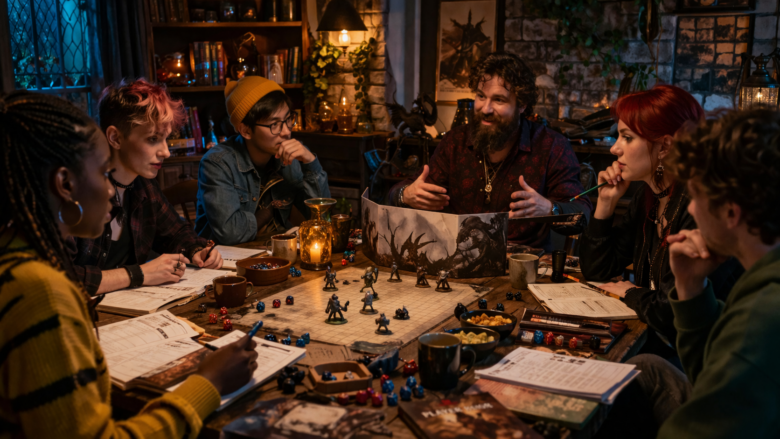
Shyness does not make someone a poor roleplayer. A quiet player may be following the story closely, thinking through possibilities, or waiting for an opening that never quite arrives. Tabletop RPGs often reward quick improvisation and confident interruption, but those are not the only valuable ways to participate.
This step-by-step guide offers practical ways to reduce pressure before and during play. It also explains how Game Masters and fellow players can make room for quieter voices without treating anyone as a problem to fix.
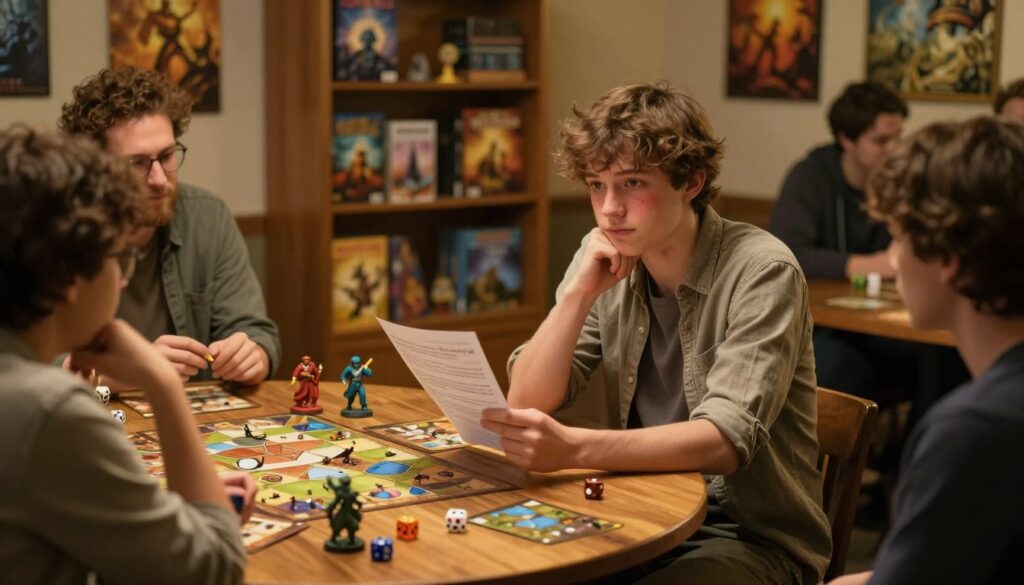
The aim is not to turn every reserved player into the loudest person at the table. It is to help each participant contribute in ways that feel manageable, meaningful, and enjoyable. Progress might mean delivering an in-character speech, but it could just as easily mean asking one useful question, declaring an action clearly, or telling the group when something is uncomfortable.
Start by Identifying What Is Getting in the Way
Quietness has many possible causes. A player might be shy around unfamiliar people, uncertain about the rules, worried about making a poor decision, uncomfortable with acting, or simply slower to formulate an answer. Introversion, language differences, hearing or speech difficulties, fatigue, and the pace of group conversation can also affect participation.
Shyness and self-doubt can overlap, but they are not identical. Shyness generally concerns discomfort in social situations. Diffidence means lacking confidence in the value of your own ideas or abilities. Neither term should be used to diagnose someone, and not every quiet participant experiences either one.
Before choosing a solution, ask a more useful question: What would make participation easier?
- If speaking in front of the whole group is difficult, a private conversation with the GM may help.
- If improvisation is the problem, prepared notes and third-person narration can reduce the burden.
- If rules uncertainty causes hesitation, a concise reference sheet or rules helper may be useful.
- If interruptions are the issue, the group may need a clearer turn-taking structure.
- If the player is content listening and still makes decisions when needed, there may be no problem to solve.
Do not assume that a quiet person wants coaching. Ask privately and accept the answer. A player can enjoy an RPG without performing voices, initiating every conversation, or competing for the spotlight.
If anxiety causes serious distress beyond the game table, tabletop play should not be presented as a substitute for professional support. An RPG can provide opportunities to practice communication, but it is still a recreational activity rather than treatment.
Step 1: Set Expectations Before the Campaign
A session zero is the best time to establish how the group will play together. It can cover the campaign premise, rules, character creation, expected tone, content boundaries, attendance, and the way spotlight time will be shared.
For a shy player, predictability is particularly useful. Ask the GM what a typical session looks like. Will the campaign emphasize tactical combat, open-ended investigation, political negotiation, or character drama? How long are sessions? Are players expected to speak in character? How much rules knowledge is required at the beginning?
These questions are not requests for special treatment. They provide the information needed to prepare appropriately. A player who expects a dungeon expedition can review exploration abilities. Someone joining a court-intrigue campaign might instead prepare a few relationships, opinions, and conversation prompts.
Discuss Your Preferred Roleplaying Style
Roleplaying does not require acting. A player can speak as a character, describe the character from outside, summarize a conversation, or move between all three approaches.
- Direct dialogue: “The bridge is unstable. We should find another route.”
- Third-person dialogue: “Mara warns everyone that the bridge looks unstable.”
- Summary: “Mara explains the engineering problems and recommends another route.”
- Intent first: “I want to convince the guards that letting us through is in their interest.”
Tell the group which forms feel comfortable. A healthy table should not demand accents, dramatic monologues, or uninterrupted first-person dialogue as proof of “real” roleplaying.
Use a Private Channel When Necessary
Some concerns are easier to discuss outside the group. A short message to the GM can be specific without becoming a major announcement.
Example message: “I enjoy the campaign, but I need a little time to answer when a scene turns to me. Direct questions help, especially if I can describe my character’s intent instead of improvising exact dialogue.”
Another useful request might be: “During planning scenes, could we occasionally go around the table? I have trouble finding a gap when several people are speaking.”
Good requests identify an obstacle and suggest a practical adjustment. The GM may not be able to accommodate every preference, but clear information makes collaboration much easier.
Step 2: Build a Character Who Is Easy to Play
Character creation can either reduce pressure or accidentally increase it. A complicated personality, unfamiliar rules package, or leadership role may be exciting in theory but exhausting at the table. Choose a character whose decisions you can understand, especially for a first campaign or a new group.
Option One: Play a Reserved Character
A cautious scholar, soft-spoken healer, watchful scout, or formal knight allows hesitation to fit naturally into the fiction. You can describe pauses and uncertainty as character behavior rather than trying to conceal them.
This approach works best when the character still has reasons to act. Give the character a strong principle, duty, curiosity, or relationship that draws them into the story. “Quiet” should describe a manner of speaking, not an inability to make decisions.
For example, a reserved archivist may dislike crowds but become animated when discussing a lost civilization. A cautious ranger may say little in town yet immediately take charge when the party becomes lost. These specific triggers provide predictable opportunities to contribute.
The limitation is that a shy character can make withdrawal too easy. If both player and character always avoid attention, the rest of the group may have little material to engage with. Counter this by choosing one subject, person, or goal that reliably prompts action.
Option Two: Play an Expert
An expert character has a clear function within the party. The character might understand ancient magic, criminal organizations, noble etiquette, medicine, wilderness travel, or local history. When that subject appears, the group has an obvious reason to seek the character’s opinion.
Ask the GM how expertise will work. Players should not be expected to invent setting facts or possess the same knowledge as their characters. The GM can provide information after a successful check, send a short note, or offer several conclusions the expert might draw.
A useful exchange might look like this:
- The player says, “Tarin studies the seal. Does his background in imperial history tell him who used it?”
- The GM calls for a check or provides information automatically.
- The player relays the result: “Tarin explains that the seal belonged to a disgraced royal house.”
This structure creates an authoritative contribution without demanding unsupported improvisation.
Option Three: Play a More Assertive Character
A bold character can provide permission to make decisions that feel unusual for the player. Instead of inventing a perfect speech, begin with a clear statement of intent: “My paladin steps between the merchant and the prisoner,” or “My captain tells the council that the evacuation starts now.”
Character abilities can support the attempt, but numbers do not require a player to perform eloquence. In games with social mechanics, a high relevant score may resolve how persuasive the character is after the player explains the goal and approach.
This option is best treated as an experiment rather than an obligation. Constantly playing an impulsive leader can be tiring, and “assertive” should not become disruptive. A bold character still needs to listen, cooperate, and respect other players’ decisions.
Option Four: Establish a Character Connection
A pre-existing relationship gives two characters an immediate reason to interact. They might be siblings, former colleagues, traveling companions, rivals, members of the same order, or survivors of the same disaster.
Choose another player who is willing to share scenes rather than control them. Agree on two or three facts about the relationship and one unresolved question. For example:
- The characters trust each other in combat.
- One knows why the other left home.
- Neither has discussed what happened during their final mission together.
This creates easy conversation material while leaving room for development during play.
| Character approach | What it provides | Possible drawback |
|---|---|---|
| Reserved character | Low-pressure participation that matches the player’s natural pace | Can encourage further withdrawal unless the character has strong motives |
| Expert character | A defined subject on which the character is expected to contribute | Requires the GM to provide setting knowledge the player cannot know |
| Assertive character | Permission to practice decisive actions through a fictional role | Can be tiring or disruptive if boldness replaces cooperation |
| Connected character | A reliable scene partner and ready-made conversation topics | Depends on another player respecting the shared relationship |
Step 3: Prepare a Small Character Reference
Preparation helps most when it reduces choices rather than creating homework. A single page is usually more useful at the table than several pages of biography.
Include information that can generate immediate action:
- Three personality traits expressed as behaviors, such as “asks practical questions,” “avoids unnecessary cruelty,” and “collects local legends.”
- Two current goals.
- One fear or source of uncertainty.
- Two party members the character wants to know better.
- Three phrases or opinions that can begin a conversation.
- The character’s most important abilities and when to use them.
A simple decision rule can also prevent paralysis. A cautious investigator might “look for evidence before accusing anyone.” A devoted guardian might “protect civilians before pursuing an enemy.” These rules do not dictate every choice, but they offer a default when several options seem equally plausible.
Prepare Questions Instead of Speeches
Questions are often easier to use than prepared monologues because they invite another player to share the scene. Write two or three that fit the character:
- “Why did you join this expedition?”
- “Do you trust our employer?”
- “What will you do when we return home?”
- “You recognized that symbol. Where have you seen it before?”
These prompts work particularly well during travel, camp scenes, watches, or other moments when the party is not under immediate pressure.
Use a Visual Reference If It Helps
A portrait, symbol, miniature, or color palette can serve as a quick mental anchor. Choose art you have permission to use, especially if it will be posted publicly. The image need not define every detail; its purpose is simply to recall the character’s mood, posture, equipment, or general presence.
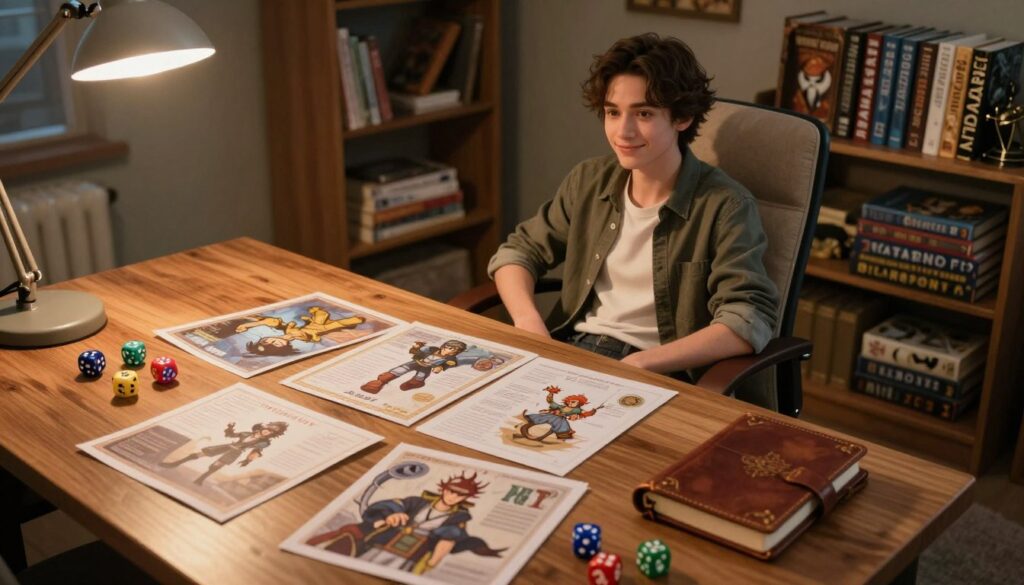
Real-world interests can also make a character easier to describe. Someone familiar with hiking may enjoy portraying a wilderness guide; a player interested in history may find a court scholar intuitive. However, the fictional setting and game rules still take precedence. Personal expertise should support play, not become a reason to correct or lecture the table.
Step 4: Begin with Description Rather Than Performance
Third-person narration is one of the most reliable low-pressure techniques in tabletop play. It separates the player from the character just enough to make participation manageable.
Instead of inventing exact dialogue, describe the approach:
- “My rogue checks whether the desk has been disturbed.”
- “Iria tries to calm the witness by speaking gently.”
- “My fighter stays near the doorway and watches for movement outside.”
- “Soren disagrees with the plan, but he explains his concern without insulting anyone.”
This is complete roleplaying. It communicates what the character does, how they do it, and often why. The GM can then ask a focused follow-up question if more detail is needed.
You may naturally move into first-person dialogue once a scene develops:
“Mara asks the guard about recent travelers. She is particularly interested in anyone carrying red banners.”
The GM answers as the guard, and the player continues: “Did they arrive before the storm?”
There is no need to choose one style permanently. Switching between description, summary, and direct speech is normal and can improve pacing for the whole group.
Step 5: State Your Intent Before Searching for Perfect Words
Many players hesitate because they believe they must present a complete solution before speaking. Instead, start with the goal.
- “I want to find out whether the mayor is hiding something.”
- “I want to distract the guards long enough for the others to enter.”
- “I think the ruins may connect to my character’s religion. Can I examine the carvings?”
- “I want to support Kestrel’s argument, but I am not sure what my character would say.”
The GM can clarify the situation, suggest relevant information, or explain which mechanic applies. This turns roleplaying into a collaborative exchange rather than a test of spontaneous eloquence.
In rules-heavy games, learn a few dependable actions instead of every possible option. Mark the attacks, spells, skills, or moves you expect to use most often. During combat, decide your likely action before your turn arrives, while remaining ready to adjust if the situation changes.
If rules uncertainty remains a barrier, ask whether another participant can serve as a rules helper. That person should offer concise options rather than taking control. “You could attack, help the cleric, or move behind cover” is useful; choosing and rolling on someone else’s behalf without permission is not.
Step 6: Set One Manageable Participation Goal
“Be more confident” is too vague to guide a session. Choose a small behavior that can be completed without dominating the game.
Possible goals include:
- Ask one character a personal question.
- Offer one plan during a group discussion.
- Describe one action with sensory detail.
- Initiate one conversation with an NPC.
- Remind the party about one useful item, clue, or ability.
- Speak in character once, even if the sentence is brief.
One contribution per session may sound modest, but it establishes a repeatable habit. If the moment does not arise naturally, do not force it. The goal is a prompt, not a pass-or-fail assignment.
After the session, review what helped. Was it easier to speak during combat because turns were structured? Did a direct question from the GM help, or did it feel too sudden? Did prepared notes reduce stress? Use the answer to adjust the next goal.
Avoid measuring progress against the group’s most talkative participant. Some players think aloud, while others speak only after reaching a conclusion. Both styles can contribute to good play.
Step 7: Use Low-Stakes Scenes as a Warm-Up
Major negotiations and dramatic confrontations carry obvious pressure. Smaller scenes offer room to practice without deciding the fate of the campaign.
Travel, shopping, watches, meals, and post-adventure downtime can support brief interactions. A character might ask where another party member learned a technique, comment on an unusual town custom, offer to repair equipment, or discuss what to do with a reward.
Keep these exchanges purposeful enough that the other player has something to answer. “Nice weather” may end immediately, while “Does this storm remind you of the night we met?” opens a scene.
Low-stakes roleplay should not consume the session if the rest of the group is ready to move on. A few lines can establish a relationship just as effectively as a long conversation. The objective is connection, not duration.
Step 8: Make Space in Fast Group Conversations
In an energetic group, ideas can disappear before a quieter player finds an opening. Occasional overlap is normal, but repeated interruption is a table-management problem rather than a personal failure.
Useful phrases for re-entering the conversation include:
- “I want to add something before we decide.”
- “Could we return to the clue from the chapel?”
- “I had an idea about the prisoner.”
- “Can I finish that thought?”
Non-verbal signals may also help. Raising a hand slightly, placing a token in a designated area, or sending the GM a short message can indicate that you are waiting to speak. Agree on the method beforehand so it is recognized.
When Another Player Dominates
A highly vocal participant may be enthusiastic, uncomfortable with silence, or unaware of how much space they occupy. The reason matters less than the effect. If one person routinely answers every question, decides other characters’ actions, or interrupts, the group should address the pattern.
A private message to the GM can focus on behavior rather than labels: “I am having trouble contributing during planning because decisions are made before I can speak. Could we use a quick round where everyone gives an idea?”
Players can also support each other directly. A confident participant might finish a point and then ask, “Nia, you noticed the tracks earlier. What do you make of this?” The invitation should be genuine, with enough silence for an answer.
Do not arrange a protective or mentor relationship between players without consent. An in-character partnership can be helpful, but no participant should be assigned responsibility for managing another adult’s confidence.
Try Structured Discussion
When the party must choose a destination, interpret clues, or make a difficult moral decision, the GM can briefly go around the table. Each player gets a chance to offer an idea or pass.
Starting with a quiet player is not always best; an unexpected first turn can feel like a spotlight ambush. Ask for preferences or vary the order. The essential features are predictability, the option to pass, and protection from interruption.
For complicated plans, a written list can help. Online groups can use text chat alongside voice. In person, someone can record the available options before the party votes or reaches consensus.
Step 9: Adapt the Techniques for Online Play
Online sessions solve some problems and create others. Text chat provides a useful secondary channel, but audio delays and missing body language can make interruptions more common.
Helpful online practices include:
- Use a digital hand-raise feature or agreed chat symbol when several people want to speak.
- Allow players to type character dialogue if speaking is difficult that day.
- Keep rules questions in text so they do not interrupt a scene.
- Let the GM know privately if audio problems, fatigue, or discomfort are affecting participation.
- Address characters by name before asking a question, giving the player a moment to prepare.
Cameras should not be treated as mandatory unless the group agreed to that condition before play. Video can improve communication for some participants while increasing self-consciousness, bandwidth problems, or fatigue for others.
Use Safety Tools That People Can Actually Access
Content boundaries and participation support are related but distinct. A player may be comfortable speaking yet need a scene to stop, or may be shy without objecting to any subject matter. Safety tools give the entire group clear ways to pause, redirect, or leave play when necessary.
Establish Boundaries Before Play
Lines and veils are a common framework. A line is content that will not appear in the game. A veil allows a subject to exist but keeps details off-screen or fades the scene to black.
Boundary information can be collected privately if discussing it in front of the group would be uncomfortable. The GM can summarize the resulting limits without identifying who requested them. Players should not be required to explain or justify a boundary.
No pre-game discussion can anticipate everything. The group also needs an in-session method for responding when unexpected content becomes uncomfortable.
Offer More Than One Signal
A spoken request such as “pause” is immediate and clear, but some players may find it difficult to interrupt verbally. Provide a silent alternative as well.
| Tool | How it works | Important limitation |
|---|---|---|
| Spoken pause | A player says an agreed word or plainly asks to pause the scene | Requires speaking while already uncomfortable |
| X-Card or similar signal | A player taps, raises, or selects a visible symbol to remove or redirect content | The action is silent but may still be visible to the group |
| Private message | A player contacts the GM discreetly during an online or in-person game | The GM must notice promptly and redirect without exposing the sender |
| Open Door | Anyone may step away from or leave the session without being pressured to remain | The group still needs a plan for checking in and resuming play |
When a signal is used, stop or redirect first. Questions can wait, and an explanation may never be necessary. Depending on the request, the group might remove a detail, rewind the scene, fade to black, take a break, or end the session.
A covert signal should not be the only tool because the GM may miss it. Agree on a backup, such as sending a second message or leaving the table temporarily. Online groups should also consider what happens if the GM is the source of the problem; another trusted participant can monitor safety messages or support a pause.
Safety tools are useful only when the group respects them. Mocking a request, demanding personal disclosure, or treating a pause as an inconvenience undermines the agreement.
Guidance for Game Masters
Game Masters influence the pace and distribution of attention, but a shy player should not become a special project. The objective is to remove unnecessary barriers while preserving the player’s control over how much they contribute.

Ask Before Increasing the Spotlight
Do not assume that more direct attention is automatically helpful. Ask privately whether the player prefers direct prompts, extra time, written information, structured turns, or fewer unexpected solo scenes.
Useful questions include:
- “Would you like me to ask what your character thinks during planning scenes?”
- “Do you prefer broad prompts or a few concrete options?”
- “Would receiving lore notes before the session make your expert character easier to play?”
- “If you need time to think, how would you like me to handle the pause?”
Revisit these preferences later. Comfort can change as the player learns the system and gets to know the group.
Use Focused Invitations
“What do you do?” can be difficult when the scene contains many possibilities. A focused invitation offers context without dictating the answer.
Instead of “What does your character think?”, try: “Your ranger recognizes that the animals are avoiding the northern trail. Do you warn the group, investigate, or keep watching?”
The player can choose an option, propose another action, or pass. The prompt makes relevant information visible and establishes why the character’s perspective matters.
After asking, allow time for an answer. Filling every silence teaches slower speakers that their turns will be taken away. A few seconds may feel long to the GM but can be necessary for someone organizing a response.
Rotate Spotlight Through Character Relevance
Design situations in which different characters possess useful abilities, relationships, or knowledge. The aim is not to create a separate quest for each player every session. Small moments are enough.
- A magical inscription relates to the wizard’s training.
- A witness belongs to the rogue’s former guild.
- A border dispute tests the knight’s oath.
- A damaged bridge calls for the artificer’s expertise.
- A frightened animal responds to the druid’s calm approach.
Provide the information needed to act. If an NPC asks the scholar for an expert opinion, give the player relevant facts rather than expecting an improvised lecture. A note with two or three findings lets the player decide how to present the conclusion.
A spotlight should also have an exit. If the player appears uncomfortable, allow another character to assist, move to a roll, summarize the exchange, or return to the wider party.
Create NPCs Who Invite, Not Demand, Interaction
A friendly NPC can provide a reliable roleplaying partner. The NPC might ask for practical advice, share a concern, or express interest in the character’s background.
Keep early questions concrete:
- “Can you identify this symbol?”
- “Which road would you take through the marsh?”
- “Do you think the prisoner is telling the truth?”
- “Will you show me how you repaired that shield?”
Concrete questions are easier to answer than requests for an emotional monologue. As the player becomes comfortable with the NPC, the relationship can support deeper scenes.
Avoid making vulnerable NPCs a constant emotional obligation. A frightened child or dependent apprentice can motivate a character, but repeated pressure to comfort or protect an NPC may feel manipulative. Check whether the player enjoys the relationship rather than assuming it is helpful.
Manage Interruptions Consistently
If someone is interrupted, return to them: “Hold that thought. Sam was still speaking.” This should be normal table facilitation, not a conspicuous favor reserved for one person.
During complex discussions, use a quick round, request ideas before debate begins, or ask players to submit options in writing. In combat, clearly announce who is acting and who is next. Predictable transitions give players time to prepare.
Do not allow one participant to declare another character’s actions. Suggestions are fine when invited, but statements such as “Your cleric heals me” or “You should use that spell” can remove agency and make a hesitant player even less likely to contribute.
Recognize Contributions Without Making Them a Spectacle
Respond to the substance of a contribution rather than praising the player for speaking at all. “That clue connects the two crime scenes” validates the idea. “Look who finally decided to talk” embarrasses the player, even if intended as a joke.
Likewise, avoid exaggerated applause after a first in-character line. Treat the contribution as a normal and welcome part of play. Private positive feedback after the session may be more comfortable: “Your question to the witness uncovered an important detail, and the pacing of that scene worked well.”
Watch for Group Fit Problems
Not every difficulty can be solved with confidence exercises. A player may struggle because the campaign style is a poor match, the rules are inaccessible, the group regularly talks over one another, or jokes are made at someone else’s expense.
If a player repeatedly leaves sessions drained or unheard, discuss concrete changes. These might include a smaller group, shorter sessions, a different game system, more written play, clearer behavior expectations, or a different table entirely.
Leaving an unsuitable group is not failure. Participation techniques cannot compensate for persistent disrespect or incompatible expectations.
A Practical Four-Session Plan
Players who prefer a structured approach can spread these techniques across several sessions. Adjust the pace freely; there is no deadline.
Session One: Establish a Reliable Baseline
Use third-person narration and focus on clear mechanical actions. Ask the GM one question before play if any rule or expectation is uncertain. The goal is simply to participate without adding performance pressure.
Session Two: Add One Prepared Interaction
Bring one question for another character and use it during a suitable quiet scene. If the opportunity never appears, save it for later rather than forcing a detour.
Session Three: Offer One Plan or Interpretation
During investigation or party planning, state one idea before evaluating whether it is the best idea. A useful format is: “I think this because of this clue, but I may be missing something.” This contributes while leaving room for collaboration.
Session Four: Try a Short Direct Exchange
Speak one or two lines as the character, perhaps to an established NPC or party member. Switch back to summary whenever needed. The experiment is successful if it provides useful information about what feels comfortable, regardless of how dramatic the scene becomes.
After four sessions, keep the techniques that improve play and discard those that feel artificial. Some players will enjoy gradually increasing direct dialogue. Others will remain primarily descriptive roleplayers, which is equally valid.
What Supportive Participation Looks Like
A successful session does not require equal word counts. It requires meaningful opportunities, respect for different communication styles, and enough structure that no one is routinely excluded.
For a shy player, the most effective path is usually incremental: understand the obstacle, communicate preferences, create an accessible character, prepare a few prompts, and use low-pressure narration. For the GM, the priorities are equally practical: ask rather than assume, protect turns, provide relevant information, and offer invitations that can be accepted or declined.
Confidence may grow with familiarity, but confidence is not the price of admission. A player who listens carefully, makes thoughtful decisions, and contributes in a quieter style already belongs at the table.

Ravenous RPG Editorial Team covers tabletop role-playing games, Game Master tools, player guides, campaign design, character building, and RPG system analysis. Articles are edited for clarity, practical usefulness, and accuracy, and are updated when corrections or material changes are needed.