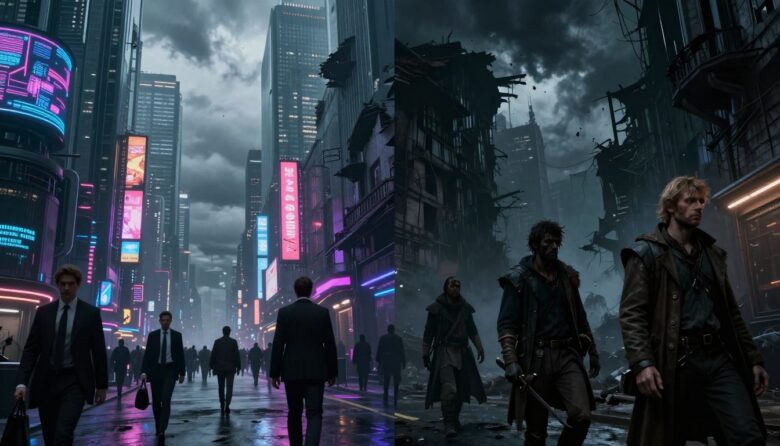
Cyberpunk and grimdark can both produce violent, morally complicated campaigns, but they create different expectations at the table. Cyberpunk usually asks what people will sacrifice to survive or resist a technologically advanced system. Grimdark asks what remains worth protecting when institutions, ideals, and perhaps the world itself are failing.
That distinction affects more than scenery. It shapes character concepts, campaign structure, equipment, combat, moral choices, and the amount of hope players expect their actions to create. A group excited by infiltration, social engineering, and dangerous technology may disengage from a campaign built around relentless attrition. Players seeking desperate last stands may find a sequence of stylish corporate heists too clean or transactional.
Neither approach is inherently better. The useful question is which one supports the experience your group wants—and whether the chosen rules can deliver it without making the game exhausting to run or unpleasant to play.
First, Cyberpunk and Grimdark Are Not Exact Opposites
Cyberpunk is usually treated as a genre. It brings together recognizable subjects and settings: advanced technology, extreme inequality, corporate power, surveillance, commodified bodies, dense cities, and people operating outside respectable society.
Grimdark is better understood as a tone or storytelling mode. It can appear in science fiction, fantasy, horror, post-apocalyptic games, or even a cyberpunk campaign. Its defining qualities are severe moral compromise, institutional corruption, pervasive violence, and victories that come at a substantial cost.
This means a campaign can be both cyberpunk and grimdark. A neon city controlled by corporations may still be grimdark if resistance is nearly futile, casualties are routine, and every apparent ally is compromised. Conversely, a cyberpunk game can retain hope: the characters may protect a neighborhood, expose a conspiracy, or build solidarity even if they cannot dismantle the entire system.
Likewise, a setting can look grim without being grimdark. Ruined castles, plague masks, and muddy battlefields establish an aesthetic, but the campaign may still feature heroic protagonists who defeat evil and restore a just order. Tone depends on what the characters can accomplish and what the story treats as meaningful, not simply on the color palette.
What a Cyberpunk Campaign Promises
Cyberpunk is often summarized as “high tech, low life.” Powerful technology exists, but its benefits are distributed unequally. A corporation may possess sophisticated medical care while people outside its protection struggle to obtain basic treatment. Artificial intelligence, cybernetic enhancement, and pervasive networks expand human capabilities while creating new forms of control.
The most useful cyberpunk conflicts are therefore social as well as technological. The question is not merely whether a character can replace an arm with machinery. It is who owns the implant, who collects its data, whether maintenance requires corporate employment, and what happens when the manufacturer withdraws support.
Cyberpunk 2077 is a familiar visual reference for neon urban excess, body modification, and corporate dominance. For tabletop play, Shadowrun combines cyberpunk concerns with fantasy elements such as magic, elves, and dragons. That hybrid makes it suitable for groups that want infiltration and cyberware without abandoning familiar fantasy archetypes.
Common Cyberpunk Themes
- Corporate power: Private organizations control employment, housing, security, health care, information, or public policy.
- Surveillance: Characters leave digital traces, appear on cameras, and attract attention when they disrupt profitable systems.
- Commodified identity: Memories, bodies, relationships, and reputations may all be products.
- Unequal access: Extraordinary technology exists, but price, status, and geography determine who benefits.
- Resistance and complicity: Characters oppose the system while depending on its money, equipment, or infrastructure.
- Transhumanism: Augmentation raises questions about identity, autonomy, disability, ownership, and the limits of the human body.
Typical Cyberpunk Player Characters
Cyberpunk parties are often crews of specialists. A hacker penetrates networks, a combat expert handles physical security, a technician manages equipment, a negotiator deals with clients, and a well-connected fixer finds work or information. The exact roles depend on the game, but the party usually succeeds by combining distinct capabilities.
These characters are rarely conventional heroes backed by legitimate authority. They may be mercenaries, activists, investigators, smugglers, journalists, gang members, corporate defectors, or residents protecting their community. Their motives matter because a campaign built entirely around accepting jobs can become repetitive. Personal loyalties and conflicting obligations give each operation consequences beyond payment.
A useful cyberpunk character needs at least three connections:
- Someone or something the character wants to protect.
- An institution the character resents, fears, or depends upon.
- A person who can provide opportunities but may demand a favor later.
These connections turn an anonymous city into a playable social network. They also give the game master alternatives to simply threatening the characters with larger weapons.
Typical Cyberpunk Campaign Structure
The job or heist is a natural cyberpunk scenario. A client presents an objective, the crew investigates, the players choose an approach, the operation encounters complications, and the aftermath changes faction relationships. That structure supports planning, specialized roles, and difficult decisions.
A strong operation should permit more than one method. The crew might enter a facility with forged credentials, recruit an employee, compromise a delivery system, use a maintenance route, negotiate with a rival faction, or attempt a direct assault. If every scenario eventually becomes a firefight in a corridor, much of the genre’s appeal is lost.
The aftermath is equally important. Stolen data may expose a company while also revealing private information about innocent employees. A successful extraction may create a dangerous refugee. Sabotaging a production line may hurt the corporation but leave a neighborhood without medicine. Cyberpunk works best when the characters can act decisively but cannot isolate themselves from the effects.
Where Cyberpunk Can Frustrate a Group
Cyberpunk games may demand considerable rules knowledge. Hacking, vehicles, drones, cyberware, firearms, armor, and social influence can become separate subsystems. If only one character participates in a detailed hacking sequence, the rest of the table may spend too long waiting.
Planning can also stall play. Some groups enjoy debating entrances, schedules, and contingency plans; others find an hour of preparation less exciting than the operation itself. The game master can reduce this problem by making useful information accessible, clarifying obvious risks, and avoiding hidden details that invalidate sensible plans.
Finally, the genre’s imagery can overshadow its substance. Neon signs and mechanical limbs do not automatically create cyberpunk. Without inequality, institutional pressure, and questions about who controls technology, the campaign may become ordinary action-adventure with futuristic equipment. That may still be enjoyable, but the group should recognize what it is choosing.
What a Grimdark Campaign Promises
Grimdark settings present worlds in which cruelty and corruption are systemic rather than exceptional. Governments may be oppressive, religions fanatical, armies expendable, and supernatural forces actively hostile. People survive through compromise, loyalty, denial, or violence.
Warhammer 40,000 is the most recognizable grimdark reference in the supplied examples. Its vast wars, decaying institutions, fanaticism, and existential threats establish a scale on which individual lives can appear insignificant. Tabletop role-playing games set in that universe can narrow the focus to investigators, soldiers, agents, or other groups attempting to complete missions inside the larger catastrophe.
The Dark Souls video games provide another tonal reference: ruined places, fragmented histories, cycles of failure, and perseverance against powerful enemies. Those qualities can inform tabletop atmosphere, but punishing video-game combat does not translate automatically into good role-playing. A tabletop campaign must account for ongoing characters, shared spotlight, and the consequences of a single unlucky roll.
Common Grimdark Themes
- Institutional decay: The organizations that claim to preserve order are corrupt, incompetent, or monstrous.
- Scarcity: Food, medicine, ammunition, shelter, trustworthy information, or safe travel may be difficult to obtain.
- Compromised morality: Characters frequently choose between harmful outcomes rather than between obvious good and evil.
- Attrition: Injury, stress, corruption, and lost resources accumulate over time.
- Fanaticism: Ideologies promise certainty while justifying cruelty.
- Defiant endurance: Meaning comes from preserving something valuable despite overwhelming pressure.
Typical Grimdark Player Characters
Grimdark protagonists are often soldiers, investigators, survivors, condemned people, mercenaries, pilgrims, disgraced nobles, or agents of compromised institutions. Some may be sincere believers; others serve because desertion would be worse. They need not be vicious, incompetent, or permanently miserable.
In fact, characters require something worth caring about if grim choices are to matter. A soldier who values comradeship, a healer trying to preserve professional ethics, or a priest troubled by the actions of the church creates more drama than an indiscriminately cruel anti-hero. If every character begins with no principles, there is little left for the setting to threaten or erode.
Useful grimdark characters often have:
- A duty they cannot easily abandon.
- A belief they are beginning to question.
- A line they do not intend to cross.
- A person, place, or tradition that represents a better world.
The last point is especially important. Without contrast, relentless darkness becomes emotionally flat. Small moments of loyalty, humor, beauty, or mercy make the surrounding brutality more effective.
Typical Grimdark Campaign Structure
Grimdark scenarios often revolve around dangerous obligations. The party must hold a position, investigate a corrupt authority, escort scarce supplies, survive a siege, cross contaminated territory, suppress an uprising, or decide which community receives limited aid.
The objective may be achievable even when the wider crisis is not. The characters cannot end an eternal war, but they can evacuate civilians from one district. They cannot cleanse an empire of corruption, but they can expose one official. They cannot prevent every death, but they can decide who receives protection and what price they will pay.
This distinction preserves agency. Grimdark does not require the game master to negate every victory. It requires victories to exist within a hostile context. A doomed world can still contain meaningful choices.
Where Grimdark Can Frustrate a Group
Bleakness becomes monotonous when every non-player character is treacherous, every rescue fails, and every moral choice produces the same punishment. Players stop deliberating if they learn that all decisions lead to identical misery. A campaign needs consequences that reflect what the group actually chose.
High lethality can also work against character-driven play. Frequent death suits a short military scenario or a campaign about expendability, but it may undermine long-term relationships and personal arcs. Groups should decide whether death is common, whether replacement characters are easy to introduce, and whether permanent injuries are a central feature or an occasional risk.
Grimdark material may involve torture, dehumanization, religious abuse, body horror, prejudice, or violence against civilians. None of those subjects should be treated as automatic signs of maturity. They require agreement about boundaries and careful handling. A restrained description can establish horror more effectively than prolonged graphic detail.
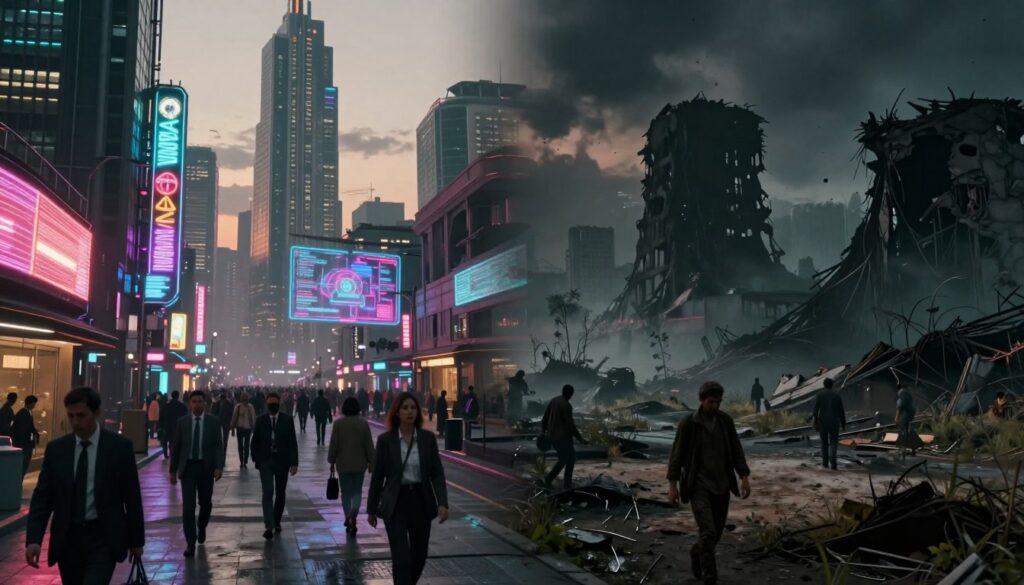
Cyberpunk vs. Grimdark at the Table
The following comparison describes common tendencies rather than mandatory rules. A particular system may reverse several of them, and a campaign can deliberately blend both approaches.
| Campaign Element | Cyberpunk Tendency | Grimdark Tendency |
|---|---|---|
| Primary pressure | Surveillance, debt, corporate retaliation, and technological dependence | War, scarcity, corruption, attrition, and failing institutions |
| Typical party | A crew of specialists connected by work, community, or rebellion | Survivors or agents bound by duty, catastrophe, or mutual dependence |
| Common scenario | Infiltration, extraction, sabotage, investigation, or data theft | Last stand, dangerous journey, purge, siege, survival mission, or compromised investigation |
| Useful resources | Contacts, credentials, information, cyberware, vehicles, and access | Food, ammunition, medicine, shelter, morale, and trustworthy allies |
| Common consequence | Heat, damaged reputation, debt, faction hostility, or compromised identity | Injury, trauma, corruption, depleted resources, or loss of territory |
| Typical victory | Outsmarting a powerful organization or reclaiming limited autonomy | Preserving lives, principles, or territory despite severe cost |
| Failure feels like | The system anticipating, identifying, or co-opting the crew | The world grinding down the party faster than it can recover |
| GM preparation | Networks, locations, security layers, clients, and faction responses | Threats, resource pressure, moral stakes, fronts, and cumulative consequences |
How the Choice Changes Game Mechanics
Genre alone does not determine mechanics. Not every cyberpunk game has elaborate hacking rules, and not every grimdark game uses permanent injury tables. Before choosing a system, examine what its rules actually reward.
Information and Planning
Cyberpunk usually benefits from mechanics that make reconnaissance valuable. Players need ways to discover security arrangements, identify leverage, acquire credentials, and prepare equipment. Information should create meaningful options rather than merely reveal the one solution the game master expected.
Grimdark games also use information, but uncertainty often carries more weight. Reports may be incomplete, authorities may conceal failures, and witnesses may be frightened or indoctrinated. This should create difficult judgment calls, not arbitrary guessing. Players still need enough evidence to make informed decisions.
Specialist Roles and Spotlight
A cyberpunk crew may divide into sharply defined roles. This creates satisfying teamwork, but it also risks splitting the party into separate physical, digital, and social scenes. A useful system resolves specialist actions quickly or gives other characters ways to contribute.
Grimdark parties may have broader overlap because everyone must survive the same danger. Even so, one character may dominate combat while another handles medicine, investigation, logistics, or morale. The campaign should include problems that make those non-combat capabilities consequential.
Combat and Injury
Cyberpunk combat is often lethal because firearms and advanced weapons are dangerous. That does not mean every encounter should become a battle. Security systems, legal consequences, corporate response teams, and medical costs can make avoidance preferable. Combat works best when it is one tool among several.
Grimdark combat often emphasizes attrition and lasting consequences. If injuries persist, the system also needs workable recovery rules. Otherwise, characters may enter a downward spiral in which previous harm makes future harm unavoidable. Some groups enjoy that pressure; others experience it as loss of control.
Ask how often the rules expect combat, how quickly characters recover, and whether death results from considered risk or a single unfortunate roll. “Brutal” is not specific enough to guide a campaign.
Progression
Cyberpunk advancement may involve new skills, contacts, cyberware, equipment, status, or access. Each upgrade can create a question about dependence. A powerful implant might require maintenance from the same corporation the crew opposes. A new contact may expect reciprocal favors.
Grimdark progression can represent competence, authority, hard-earned resilience, or corruption. Advancement does not need to make characters physically monstrous or emotionally numb. It can also give them the power to protect more people, command a unit, establish a refuge, or challenge an institution.
In either genre, progression should support the campaign premise. If the game is about vulnerable street operators, rapid advancement into untouchable elites may undermine it. If the game is about changing a region, purely personal combat bonuses may feel too narrow.
Player Agency: Rebellion, Endurance, and Consequences
It is tempting to describe cyberpunk as a genre of player agency and grimdark as a genre of inevitability. That comparison is too simple. Both can support meaningful choices, and both can mishandle them.
Cyberpunk characters may choose how to complete a job while remaining unable to overthrow global corporate power. Their agency is local and tactical. They decide whom to trust, what collateral damage is acceptable, and whether payment matters more than principle.
Grimdark characters may be unable to save an empire but still decide which values survive within it. Their agency may be ethical rather than triumphant. Choosing to spare an enemy, tell an unwelcome truth, or defend an abandoned settlement can define the campaign even if the wider world remains hostile.
A bleak setting does not justify predetermined outcomes. If the players devise a credible plan and accept its risks, success should remain possible. Consequences can be severe without erasing achievement. The difference between “you saved the village, but exposed your position” and “the village dies regardless” is the difference between costly agency and futility.
Match the Genre to the Group’s Preferred Play
Before selecting a game, ask what the group wants to do during a typical session. Preferences about activity are often more reliable than preferences about aesthetics.
Choose Cyberpunk When the Group Wants:
- Heists, infiltration, investigation, and layered security problems.
- Distinct specialist roles within a coordinated crew.
- Technology that creates both powers and complications.
- Faction politics, contacts, favors, and reputation.
- Urban campaigns with recurring locations and communities.
- Questions about privacy, identity, inequality, and corporate control.
- Several possible approaches to the same objective.
Cyberpunk is less suitable when the group dislikes planning, equipment management, technical terminology, or divided specialist scenes. It may also disappoint players who expect to become publicly celebrated heroes. Success is often unofficial, deniable, or deliberately hidden.
Choose Grimdark When the Group Wants:
- Survival under sustained pressure.
- Moral choices without clean answers.
- Dangerous travel, sieges, last stands, and failing institutions.
- Resource scarcity and consequences that persist between sessions.
- Characters shaped by duty, trauma, faith, or compromised loyalties.
- Victories measured by what is preserved rather than what is conquered.
- A serious tone with room for tragic or defiant heroism.
Grimdark is less suitable when players want frequent uncomplicated victories, secure heroic identities, or a comforting escape from cruelty and institutional failure. It is also a poor fit if the group uses “darkness” as permission for disruptive characters who refuse cooperation. A grim world still requires a playable party.
Choose Neither in Its Strongest Form When:
- The group wants optimistic exploration or straightforward heroism.
- Players prefer low-stress adventures without persistent consequences.
- The campaign is intended as casual drop-in play with minimal continuity.
- Body modification, surveillance, fanaticism, scarcity, or oppressive institutions are unwelcome themes.
- The game master does not enjoy tracking factions, resources, injuries, or accumulating fallout.
A lighter science-fiction, heroic fantasy, space-opera, or adventure framework may serve such a group better. A genre should support play, not become a test of whether players can tolerate its harshest conventions.
Use a Campaign Pitch Instead of a Genre Label
“Cyberpunk” and “grimdark” mean different things to different players. One person imagines stylish action, another expects political criticism, and another anticipates graphic violence. A short campaign pitch provides clearer expectations.
Cyberpunk Pitch Example
You are independent specialists protecting a crowded district from redevelopment by a medical corporation. Most sessions involve investigation, negotiation, and infiltration, with dangerous combat when plans fail. The characters can save people and change the district, but they are unlikely to dismantle the wider corporate system.
This pitch establishes scale, common activities, combat frequency, and the possibility of meaningful success. It also gives characters an immediate reason to cooperate.
Grimdark Pitch Example
You are members of a battered company escorting refugees through territory contested by a collapsing kingdom and a spreading supernatural blight. Supplies are limited, injuries persist, and authorities may demand cruel sacrifices. The campaign is bleak, but loyalty and mercy can produce real victories.
This version makes the pressure explicit without promising automatic failure. It tells players that resources and injuries matter while preserving a place for compassion.
Hybrid Pitch Example
You are scavengers and former corporate soldiers living aboard a failing orbital habitat. Replacement organs, clean air, and access to the station network are controlled by rival companies and religious factions. Jobs provide the resources to keep your community alive, but every enhancement and alliance creates a new obligation.
The hybrid combines cyberpunk’s technological dependence with grimdark scarcity and institutional decay. Such a campaign can be compelling, but it is also emotionally and mechanically demanding. The group should decide where hope remains visible.
Running Cyberpunk Well
A cyberpunk game master should prepare pressures and relationships rather than a single correct route. For each important location, consider its public entrance, restricted areas, security measures, human vulnerabilities, network access, and emergency response. Players can then combine social, technical, and physical methods.
Corporations should not behave as all-knowing villains. Large organizations contain rival departments, careless employees, contractors, whistleblowers, and incompatible objectives. Those fractures create opportunities for the crew and make the setting more believable.
Give the characters recurring places that are not mission sites: a clinic, food stall, workshop, community center, club, or apartment block. These locations show what the characters are fighting for. They also allow consequences to appear through changed relationships rather than constant combat.
Keep technology understandable at the point of use. Players do not need a technical lecture to decide whether to spoof a badge, jam a signal, or infect a local system. Explain the available action, risk, and likely consequence in terms that support a decision.
Running Grimdark Well
A grimdark game master should ration despair as carefully as any physical resource. Contrast is essential. Allow rest, camaraderie, beauty, jokes, rituals, and sincere kindness. These moments do not weaken the tone; they establish what can be lost.
Make different bad choices produce different results. Saving a group of civilians might deplete supplies, while abandoning them preserves military strength but damages morale and future alliances. Neither result needs to be painless, but the decision should matter.
Use violence purposefully. Repeated graphic descriptions can numb the table and obscure the stakes. Often the aftermath—a silent home, an abandoned uniform, a ration book with a child’s name—communicates devastation more effectively.
Most importantly, do not confuse grimdark with hostility between players. Characters may distrust one another, but the players need a reason to collaborate. Establish whether betrayal is allowed, whether it requires consent, and whether party conflict should remain verbal rather than lethal.
Session Zero Questions for Either Genre
A focused session zero helps the group select the right tone and prevents genre assumptions from becoming later disputes. Discuss the following before character creation:
- How much hope should the campaign contain? Can the characters improve a neighborhood, save a community, or reform an institution?
- How lethal should combat be? Is death expected, rare, or limited to dramatically appropriate circumstances?
- How persistent are injuries and trauma? Will recovery occupy play, or will it occur mainly between sessions?
- How much planning does the group enjoy? Should operations involve detailed preparation or move quickly into action?
- How complex should technology be? Does the group want dedicated hacking and equipment systems or broad skill checks?
- Which themes are welcome? Discuss surveillance, body modification, addiction, torture, fanaticism, prejudice, medical horror, and violence against civilians separately rather than approving “dark content” as a single category.
- What is off limits? Record clear lines, topics that may occur only off-screen, and a method for pausing play if a scene becomes uncomfortable.
- Why does the party stay together? Shared employment is a start, but loyalty, community, duty, or mutual dependence creates a stronger campaign.
- What counts as victory? Agree whether the characters can change the setting, achieve only local wins, or simply choose how they face an inevitable disaster.
These answers are more important than strict genre purity. A hopeful cyberpunk resistance game and a fatalistic cyberpunk crime game require different characters even though both use neon cities and cyberware. The same is true of a grimdark military campaign and a grimdark investigation.
Making the Final Choice
Choose cyberpunk when the group is energized by specialist crews, contested technology, urban factions, and operations with multiple solutions. Choose grimdark when the group wants sustained pressure, compromised institutions, costly decisions, and characters who find meaning through endurance.
If both appeal, decide which element will dominate. A cyberpunk campaign with occasional grim consequences remains different from a grimdark campaign whose scarce resources happen to include cybernetics. Identify the main activity, the expected level of hope, and the consequences the rules will emphasize.
The best choice is not the harshest setting or the most fashionable aesthetic. It is the one that gives every player a reason to engage, gives the game master material they can sustain, and makes the group’s decisions matter. Neon rebellion and desperate survival can both support memorable tabletop role-playing, provided the campaign is honest about what each session will ask of the people at the table.

Ravenous RPG Editorial Team covers tabletop role-playing games, Game Master tools, player guides, campaign design, character building, and RPG system analysis. Articles are edited for clarity, practical usefulness, and accuracy, and are updated when corrections or material changes are needed.