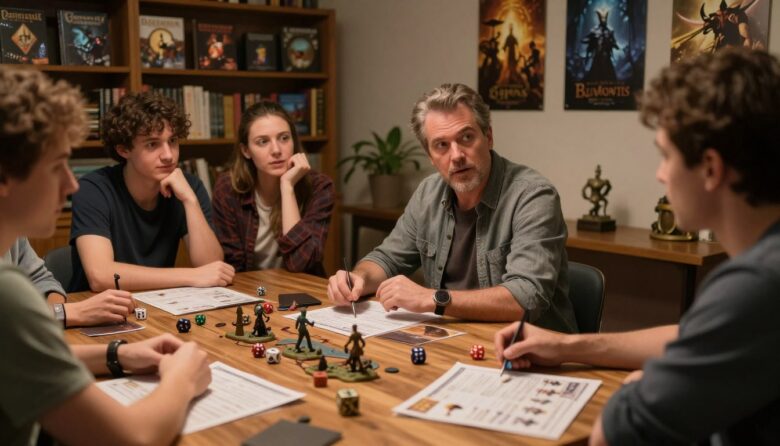
Players will ignore clues, befriend villains, abandon carefully prepared routes, and pursue minor details with unexpected enthusiasm. That is not a failure of Game Mastering. It is a predictable result of giving players meaningful choices.
Improvisation does not mean inventing an entire campaign without preparation. It means making consistent decisions when play moves beyond the prepared material. The most reliable approach combines flexible prep, clear stakes, reusable components, and the confidence to pause when necessary.
First, Identify What Kind of Derailment Happened
Not every unexpected choice requires the same response. Before inventing new material, determine what has actually changed.
- The route changed: The party still wants to stop the necromancer, but it chose the river instead of the mountain pass. This is usually easy to handle with portable locations and encounters.
- The immediate goal changed: The party has become more interested in a missing merchant than the haunted castle. Follow that interest while considering how the neglected threat develops.
- The campaign premise changed: Everyone agreed to investigate the haunted castle, but the players now want to run a bakery and avoid adventuring. This may require an out-of-character conversation rather than an improvised plot.
- A boundary was crossed: A proposed action conflicts with the table’s agreed tone, safety tools, or social expectations. Stop and address the issue directly instead of solving it through fictional punishment.
That distinction matters. A changed route is an improvisation problem. A rejected campaign premise is a group-expectations problem.
Prepare Situations, Not Scripts
A scripted plot depends on players making particular decisions in a particular order. A prepared situation remains useful regardless of the route they take.
For each major situation, establish:
- Who is involved and what each party wants.
- What resources, authority, or information they possess.
- What will happen if the player characters do nothing.
- What signs reveal that the situation is changing.
- Which consequences are likely if the characters intervene.
Suppose a merchants’ guild is secretly funding smugglers. The useful preparation is not a sequence of scenes the players must follow. It is the guild’s objective, the smugglers’ route, the officials who benefit, and the evidence that could expose them. The characters might investigate the docks, question a caravan driver, infiltrate a banquet, or ignore the matter entirely. The underlying situation can respond to any of those choices.
Define the Setting’s Stable Facts
Improvisation becomes easier when the world has a few reliable principles. These might include:
- Magic is licensed and closely monitored.
- The city watch protects wealthy districts first.
- The local temple offers healing but demands public service.
- The duke needs trade revenue more than justice.
- Undead creatures are drawn to a particular ruin.
These facts act as decision-making shortcuts. When an unexpected question arises, the answer can follow from the setting instead of being invented without context.
Give Important NPCs Motives
A short motive is often more useful than a page of biography. If the guard captain wants promotion, the innkeeper needs money, and the cultist fears exposure, their reactions become easier to judge.
For an improvised NPC, record three elements:
- Want: What does this person need right now?
- Leverage: What can this person offer or threaten?
- Tell: What visible habit, mannerism, or detail makes the person distinct?
For example: “Mara, a nervous courier, wants safe passage out of town. She knows which official accepted a bribe and repeatedly checks the street while speaking.” That is enough to support a useful scene.
Build a Small Improvisation Toolkit
Broad, reusable material is more valuable than deeply detailing places the party may never visit. A practical session kit might include:
- A list of setting-appropriate names.
- Several NPC motives and personality cues.
- Two or three simple locations that can be adapted.
- Likely creature or opponent statistics from the game being used.
- A few rumors, clues, complications, and rewards.
- A summary of active factions and their next moves.
- Rules references for mechanics likely to arise.
Prepare Modular Locations
A location can be designed around its function rather than a fixed point on the map. A concealed meeting place might become a cellar beneath an inn, a riverside warehouse, or a chamber inside an abandoned shrine.
For each location, note:
- Its original purpose.
- Two memorable sensory details.
- Something the characters can interact with.
- An immediate danger or source of pressure.
A forgotten shrine might smell of wet stone and burnt herbs, contain a cracked offering basin that opens a hidden compartment, and slowly flood while the characters investigate. Those details create play without requiring a complete room-by-room history.
Prepare Encounters Around Objectives
An encounter is more flexible when it has an objective beyond defeating every opponent. Possible objectives include escaping, delaying pursuers, protecting a witness, stealing evidence, completing a ritual, or surviving until help arrives.
This also makes reskinning easier. The structure of an encounter involving guards defending a gate could become mercenaries protecting a warehouse. Their motives, appearance, and surroundings change even if the underlying mechanics remain similar.
Use a Reliable Procedure in the Moment
When players make an unexpected choice, resist the urge to answer before understanding their intent. A short sequence can prevent many poor rulings.
- Clarify the goal. Ask what the player is trying to accomplish, especially if the proposed method is unclear.
- Review established facts. Consider what has already been described, what the characters know, and what the relevant NPCs want.
- Decide whether a roll is needed. If success is certain or failure would add nothing, simply describe the result.
- State the stakes. Explain obvious risks before the player commits.
- Resolve the action. Use the game’s normal mechanics and difficulty benchmarks where possible.
- Advance the situation. Success or failure should change something rather than returning the scene to its previous state.
For example, a character might try to persuade a stable owner to lend the party horses. Before calling for a roll, establish what the owner wants and what failure means. The owner may agree in exchange for collateral, refuse unless the characters address a local threat, or alert the authorities if threatened. Each outcome creates a new decision.
Use “Yes, And” Carefully
“Yes, and” is useful advice from theatrical improvisation, but it should not be treated as an obligation to approve every proposal. Players control their characters’ intentions and actions; they do not automatically control undiscovered facts about the world.
Several responses are available:
- Yes, and: Accept the idea and add a development. “Yes, you can swing from the chandelier, and the damaged ceiling begins to collapse behind you.”
- Yes, but: Allow the attempt with a cost or complication. “Yes, the fence can get you inside, but she wants a share of anything you recover.”
- No, but: Preserve an established limitation while offering another route. “No, the sealed stone door cannot be picked, but the draft suggests another entrance nearby.”
- No: Use this when an action is impossible, violates established fiction, or crosses a table boundary. Explain the reason clearly.
If a player asks whether there is a secret passage, the answer should follow from the location and the game’s procedures. The question may inspire a passage, but automatically confirming every suggestion can make investigation feel arbitrary.
Let Failure Change the Situation
A failed roll does not have to stop the adventure. When progress depends on a single check, consider allowing the characters to gain what they need while introducing a consequence.
Useful consequences include:
- The action takes longer than expected.
- A resource, favor, or item is spent.
- The characters attract attention.
- An NPC’s attitude worsens.
- The party gains incomplete or complicated information.
- The characters succeed but end up in a dangerous position.
- An opposing faction advances its plan.
If the party fails to pick the archive door, the result need not be “nothing happens.” They might open it noisily, break their tools, or take so long that a patrol arrives. The failed roll still matters, but play continues.
This approach is not appropriate for every action. Some attempts can simply fail, particularly when the players have other clear options. The important distinction is whether failure creates a decision or merely produces a dead end.
Protect Player Agency When Reusing Material
Unused preparation is not wasted. Maps, NPCs, clues, and encounters can be adapted for later sessions. The ethical limit is straightforward: reuse material without erasing the consequences of player choices.
A prepared shrine can be placed in an undefined part of the wilderness. A traveling scholar can appear in a town the characters chose to visit. A clue can move to another logical source if the original source never entered play.
Problems arise when every route secretly produces the same outcome. If the party takes significant precautions to avoid a dangerous bridge, moving the identical ambush to the next road invalidates that decision. The world should acknowledge the difference between caution and recklessness, diplomacy and violence, speed and thoroughness.
Before relocating prepared content, ask:
- Has this element already been established in the fiction?
- Would moving it contradict a clue or previous decision?
- Does the new location make sense?
- Will the players’ choice still produce a distinct consequence?
Portable preparation works best in unmapped or undefined spaces. Once something has been revealed, it should generally remain true.
Turn Player Interest into Material
Players reveal what interests them through their questions, theories, and choices. If they repeatedly return to an NPC, speculate about a symbol, or investigate a minor faction, that attention is useful information.
It is reasonable to develop an overlooked element because the group finds it compelling. However, avoid making every player theory retroactively correct. Predictability can weaken mystery, and changing answers solely to match speculation may invalidate earlier clues.
A better approach is to borrow the energy of a theory rather than copy its conclusion. If players suspect that a mercenary serves the thieves’ guild, the mercenary could instead owe the guild money, be investigating it, or be trying to frame it. Their interest shapes the story without making deduction meaningless.
Questions can also distribute some creative work:
- “What does your character notice first about this district?”
- “Who in this town might owe you a favor?”
- “What rumor have you heard about this ruin?”
- “What makes this religious ceremony unfamiliar to you?”
Use answers that fit the campaign’s tone and established facts. The GM remains responsible for adjudicating what becomes true.
Make Consistent Mechanical Rulings
Improvised fiction still needs fair mechanics. Unexpected plans should not be punished with arbitrary difficulty simply because they bypass prepared content.
- Use existing rules before creating a new subsystem.
- Base difficulties on the situation, not on whether the plan is convenient for the GM.
- Use familiar statistics and reskin them when an exact creature or NPC is unavailable.
- Tell players about obvious risks and likely costs.
- Apply similar rulings consistently across characters and sessions.
When a rule cannot be found quickly, make a temporary ruling and continue. Note the question, check it after the session, and explain any future change before it matters. A transparent provisional ruling is usually better than a long interruption.
Some material is less suitable for spontaneous invention. Complex tactical encounters, tightly constructed mysteries, puzzles, and sensitive subjects benefit from deliberate preparation. Improvisation complements prep; it does not make every form of prep unnecessary.
Know When to Pause or End a Scene
A brief pause is a legitimate GM tool. If an unexpected decision requires several connected answers, say that a moment is needed to consider the consequences. A short break can provide time to select statistics, sketch a location, or decide how factions respond.
It is also acceptable to end a session earlier than planned if the party has made a major transition that deserves proper preparation. This is particularly useful when the group enters a complex location, starts an unanticipated conflict, or commits to an entirely new campaign direction.
Do not disguise interpersonal problems as fictional consequences. If a player repeatedly undermines the group, ignores agreed boundaries, or treats every scene as a contest against the GM, address the behavior outside the fiction. Sending stronger guards or increasingly powerful enemies after the character rarely solves the actual problem.
Record What Became True
Improvised details become part of the setting once introduced. A simple running log helps prevent accidental contradictions.
During play, capture only what is necessary:
- New NPC names and motives.
- Promises, debts, threats, and favors.
- Locations created during the session.
- Clues revealed to the players.
- Faction actions and unresolved consequences.
- Temporary rules decisions that need review.
After the session, turn those notes into a short summary while the events are still clear. Move reusable but unseen material into a separate file rather than leaving it mixed with established campaign facts.
The best note-taking method is the one that remains easy to consult during play. A paper notebook offers speed and few distractions. Digital notes are easier to search and reorganize. Either works if names, decisions, and unresolved threads can be found quickly.
A Practical Example: The Party Opens a Bakery
Suppose the campaign points toward a haunted castle, but the characters decide to lease a shop and start baking. The appropriate response depends on why they made that choice.
If the bakery is a brief diversion, use it to reveal character relationships and connect the business to existing events. A supplier may know about missing caravans. Refugees from the castle’s surrounding lands may arrive in town. Strange frost could spoil ingredients as the haunting grows stronger.
If the players genuinely want a business-focused campaign, pause and discuss whether everyone—including the GM—wants to change direction. The haunted castle can remain an advancing background threat, be retired, or become part of a new premise. No amount of improvisation can replace agreement about what game the group wants to play.
The key is consequence rather than coercion. Ignoring the castle may allow its threat to develop, but it should not force the characters onto a predetermined path. Their decision changes the campaign, and the world responds.
An Emergency Checklist for a Derailed Session
When the notes no longer apply, use this short sequence:
- Ask what the characters are trying to achieve.
- Take a brief pause if the intention changes the session substantially.
- Choose one relevant NPC or faction and determine its response.
- Place a simple obstacle between the characters and their goal.
- Offer information, risk, and at least one meaningful decision.
- Use familiar mechanics rather than inventing unnecessary rules.
- Record every new fact introduced.
- After the session, decide which consequences will develop next.
Becoming More Comfortable with Improvisation
Improvisation improves through manageable practice. Start with low-risk elements: an NPC’s mannerism, a shop description, a minor complication, or the consequence of a failed check. There is no need to improvise an entire political system during the first attempt.
Good improvisation is not constant novelty. It is the ability to connect established facts, player choices, and game mechanics into a credible next development. Prepare flexible components, respect decisions, allow consequences to move play forward, and pause when the campaign needs more thought.
Players will still surprise the GM. The goal is not to prevent that. It is to make their surprises usable.

Ravenous RPG Editorial Team covers tabletop role-playing games, Game Master tools, player guides, campaign design, character building, and RPG system analysis. Articles are edited for clarity, practical usefulness, and accuracy, and are updated when corrections or material changes are needed.