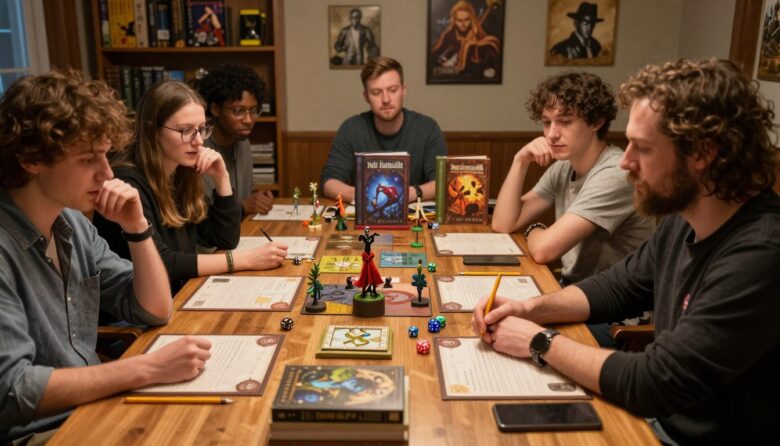
A session can be busy without being engaging. The characters may fight enemies, gather clues, and cross half the map while the players remain uncertain about what matters or why their decisions count.
Narrative engagement usually comes from a simpler combination: clear situations, meaningful choices, visible consequences, and enough shared information for everyone to act confidently. The Game Master does not need to write a novel or improvise every detail. The more useful goal is to prepare material that responds well to play.
The five techniques below address common problems at the table: slow openings, rigid plots, passive players, consequences that disappear, and confusion about the fictional environment. None can guarantee enthusiasm from every player in every session, but each provides a practical way to make participation easier and decisions more significant.
What Player Engagement Actually Looks Like
Engagement is not the same as constant excitement. A tense negotiation, a careful dungeon search, and a quiet conversation between characters can all hold attention. Nor does engagement require every player to perform dramatically or speak for an equal amount of time.
Look instead for signs that players understand the situation and want to influence it:
- They ask questions that could change their decisions.
- They discuss risks, priorities, and possible consequences.
- They refer to established characters, locations, promises, or clues.
- They make choices based on their characters rather than waiting for the GM’s preferred answer.
- They react when the world acknowledges something they did earlier.
Disengagement also has causes that narrative technique cannot fix by itself. Fatigue, scheduling problems, unclear rules, spotlight imbalance, inaccessible materials, interpersonal tension, or a mismatch in preferred play styles may be responsible. If one player wants tactical combat while another expects political drama, sharper scene framing will not resolve the difference on its own.
Before changing the campaign, ask the group what they enjoy, what has been dragging, and what they want to see more often. A brief conversation is more reliable than trying to infer everything from body language. Narrative tools work best after the group has agreed on the game’s basic premise, tone, boundaries, and priorities.
First, Identify the Session’s Main Source of Conflict
Conflict gives players something to push against. It need not mean combat, and it should not be added merely to make every scene louder. It can be any obstacle that places incompatible goals, values, or needs in tension.
Four broad forms are especially useful for session preparation:
- Character versus environment: The dungeon, wilderness, weather, distance, scarcity, or hazardous terrain creates the problem. This is central to many exploration and survival games.
- Character versus character: An NPC, rival group, monster, or faction wants something incompatible with the party’s goals.
- Character versus society: Laws, customs, institutions, or entrenched power constrain what the characters can do.
- Character versus self: A character’s beliefs, obligations, fears, desires, or relationships pull in different directions.
A session can contain several forms of conflict, but choosing a primary one helps focus preparation. If the session is about crossing a frozen pass, weather and dwindling supplies should matter. If it is about persuading a divided council, the important material is likely to be competing interests, leverage, and political consequences.
Internal conflict works best when it becomes a visible choice. “The paladin feels conflicted” gives the table little to act on. “The paladin can protect the witness only by breaking an oath to the crown” creates a decision that changes the scene. The GM should present the pressure without dictating what the character feels or chooses.
The Five Techniques at a Glance
| Technique | Problem it addresses | Core practice |
|---|---|---|
| 1. Start with pressure | Slow or uncertain scene openings | Begin when a decision, threat, demand, or opportunity is already present. |
| 2. Prepare situations, not outcomes | Railroading and wasted preparation | Define people, motives, obstacles, and stakes without deciding how the players must resolve them. |
| 3. Share narration strategically | Passive participation and weak ownership | Invite players to describe appropriate details without surrendering hidden information or established facts. |
| 4. Loop choices into consequences | A static world and choices that feel cosmetic | Bring earlier actions, promises, allies, and mistakes back into play. |
| 5. Maintain a shared fictional picture | Confusion, accidental mistakes, and stalled decisions | Describe actionable details, answer questions generously, and confirm important spatial facts. |
1. Start Scenes with Immediate Pressure
A weak scene opening often provides a location but no reason to act. “You arrive at the tavern. What do you do?” may be sufficient when the players already have a clear objective. If they do not, the question transfers the burden of creating momentum to them.
A stronger opening begins at the point where something changes. In RPG discussions, this kind of disruptive situation is often called a “bang.” It does not need to be an explosion, attack, or surprise betrayal. It is simply a development that demands attention and leaves the response open.
Compare these openings:
- Instead of “You enter the audience chamber,” try “The duke sets the stolen seal on the table and asks which of you entered his private archive.”
- Instead of “You travel north for three days,” try “On the third morning, the bridge is gone and fresh wagon tracks lead toward the flooded ford.”
- Instead of “You begin shopping in the market,” try “The armorer recognizes the crest on your damaged shield and quietly locks the shop door.”
- Instead of “You reach the abandoned shrine,” try “The shrine bell rings once from inside, although its rope lies cut at your feet.”
Each opening gives the players something concrete to interpret. None dictates the correct response. They can lie to the duke, investigate the tracks, confront the armorer, retreat from the shrine, or pursue another plan.
Build Pressure from Three Parts
A useful scene starter usually contains:
- A change: Something has happened or is about to happen.
- A stake: The change threatens, exposes, costs, or offers something relevant.
- An open response: The players retain meaningful options.
For example: “The prisoner offers the location of the missing children, but only if the party releases her before the guards arrive.” The change is the offer, the stake is both the children and the prisoner’s fate, and the group can accept, refuse, negotiate, deceive, or seek another source.
Do Not Confuse Pressure with Forced Action
Starting late in a scene does not justify deciding what the characters already did. “You agreed to the assassin’s bargain” removes agency. “The assassin has made an offer and expects an answer before the candles burn out” creates pressure while preserving it.
Likewise, not every scene needs an emergency. Constant ambushes and countdowns can make a campaign exhausting and flatten its pacing. Quiet scenes remain valuable when the characters have something meaningful to discuss, recover from, investigate, or anticipate.
This technique is most useful when a session begins slowly, travel feels routine, or the players are waiting for a clear point of interaction. It is less useful when the group is already pursuing a strong plan. Interrupting that plan merely to inject excitement can make the world feel arbitrary.
Keep a Small Bank of Scene Starters
Prepare three or four prompts tied to the current scenario. Specific prompts are generally better than generic disasters because they reinforce existing conflicts.
- An ally requests help at an inconvenient time.
- A rival acts on information the party thought was secret.
- A resource becomes unavailable, damaged, or contested.
- An NPC offers useful information at an ethical cost.
- A previous promise comes due.
These prompts are not mandatory events. Use one only when it follows naturally from the fiction or when the table needs a new development.
2. Prepare Situations and Constraints, Not Outcomes
Many preparation problems begin with writing a sequence of required events: the party questions the innkeeper, discovers the tunnel, captures the spy, and reaches the ritual chamber in time. This looks organized, but each step depends on the players making the expected choice and succeeding in the expected way.
When they do not, the GM must either abandon the prepared material or force events back onto the planned route. Both options can be frustrating.
Situation-based preparation replaces the sequence with interacting elements:
- Who wants what?
- What prevents them from getting it?
- What will happen if nobody intervenes?
- What information is available?
- What locations, resources, and relationships matter?
- Which facts are fixed, and which details can remain flexible?
Consider a spy in a tavern. Plot-based notes might say, “The party identifies the spy, follows him to the docks, and finds a coded ledger.” Situation-based notes could say:
- The spy wants to deliver a ledger to a ship captain before midnight.
- The city guard captain is secretly protecting him.
- The tavern owner suspects trouble and wants everyone gone.
- The ledger names three officials but is written in code.
- If unopposed, the spy leaves through the kitchen and reaches the docks.
Those facts support many approaches. The party might question staff, watch the exits, bribe the captain, steal the ledger, follow the spy, create a disturbance, or miss him entirely. The situation continues to function because it was not built around one solution.
Constraints Create Useful Decisions
Rules, maps, limited resources, social obligations, and deadlines can focus creativity. A locked door is interesting only if opening it carries uncertainty, cost, danger, or opportunity. A moral code matters when following it complicates an immediate goal. A faction relationship matters when helping one group affects another.
Good constraints narrow the decision space without reducing it to a single path. Examples include:
- The mountain route is faster, but exposure checks and limited supplies make it dangerous.
- The witness will testify, but only if the party protects her family first.
- The ritual can be stopped by destroying the focus, persuading the celebrant, breaking the wards, or evacuating the intended victims.
- The duke cannot publicly support the party without losing a crucial alliance.
Constraints should be legible. Players cannot make meaningful decisions about risks they have no reasonable way to perceive. Mystery can obscure causes and identities, but it should not conceal every relevant consequence until after a choice is made.
Prepare a Likely Development, Not a Required Ending
It is reasonable to decide what NPCs will do if the characters do nothing. This gives the scenario momentum. It is different from deciding what the characters will do or how the story must end.
A simple timeline might read:
- At dusk, the smugglers move the relic from the warehouse.
- At midnight, their buyer arrives at the eastern gate.
- By dawn, the relic has left the city unless someone interferes.
Once the players intervene, update the timeline according to the new situation. Do not preserve it merely because it was prepared in advance.
This method suits campaigns that value agency, investigation, exploration, or faction play. It requires the GM to respond to unexpected plans, so it may feel less comfortable than a scripted sequence at first. The advantage is that fewer notes become useless when the players choose an unanticipated route.
3. Share Narration Strategically
Players usually control their characters’ decisions while the GM presents the surrounding world. That division is not the only possible structure, but it is common in games such as Dungeons & Dragons. Within it, small invitations to narrate can increase ownership and reduce the sense that players merely announce actions and wait for the GM to supply all meaning.
The key is to share authority with a clear boundary.
Good Moments to Invite Player Description
After the rules establish an outcome, invite the player to describe how it appears:
- “The attack defeats the knight. What does the finishing move look like?”
- “The crowd is persuaded. Which line from your speech wins them over?”
- “You escape the collapsing tower. What useful object did you nearly leave behind?”
- “Your character has lived in this district. What harmless local custom would they recognize?”
These questions give the player expressive control without asking them to decide whether the action succeeded. They work particularly well for victories, costly successes, character introductions, flashbacks, relationships, and details linked to a character’s background.
Some systems already distribute narrative authority through their rules. Follow that structure rather than layering a conflicting procedure over it.
Protect Hidden Information and Established Constraints
Do not ask players to invent the answer to a mystery unless the game explicitly supports collaborative mystery creation. “What is inside the locked chest?” can undermine discovery if the contents are supposed to be a meaningful secret. A narrower prompt is safer: “When the chest opens, what detail makes your character hesitate before reaching inside?”
Similarly, avoid using narration sharing to offload routine GM work. Repeatedly asking players to name every tavern, describe every room, or decide every NPC reaction can become tiring. Collaboration is not automatically engaging; sometimes players want to make decisions within a world they did not author.
Offer Scope and a Veto
A well-framed invitation explains what the player may establish:
- “Describe the visual effect, but the guard survives.”
- “Name one friendly contact in the district, though they cannot hold official authority.”
- “Tell us why this temple is personally important to your character.”
- “Describe how the crowd reacts, keeping in mind that the magistrate remains hostile.”
Players should also be allowed to decline. Some enjoy authoring setting details; others prefer to stay closely within their character’s perspective. A simple “Would you like to describe that, or should I?” prevents the invitation from becoming a performance demand.
Use Shared Narration to Distribute Spotlight, Not Just Flourish
Narration prompts can help quieter players contribute, but do not surprise them with broad creative demands. Ask focused questions connected to information they already possess. A cleric might explain a funerary custom. A ranger might notice how animals respond to unnatural weather. A former courtier might recognize which noble is being deliberately ignored.
This technique is useful when players seem detached from outcomes or when scenes feel like exchanges between the GM and the dice. It is not a substitute for genuine decision-making. Describing a predetermined victory does not restore agency if the player had no meaningful choice in reaching it.
4. Loop Player Choices into Later Consequences
A choice becomes more significant when the campaign remembers it. If every spared enemy vanishes, every promise is forgotten, and every damaged location resets between visits, the world can feel like a series of disconnected stages.
“Looping” is the practice of bringing an earlier action back into play. The returning element may be helpful, harmful, complicated, or simply revealing. Its purpose is not to reward every decision or punish every mistake. It is to show that actions alter relationships and circumstances.
What Can Become a Loop?
- An enemy the party spared
- An ally they neglected or protected
- A debt, oath, bargain, or threat
- A location they damaged, improved, exposed, or abandoned
- An object they sold, lost, or entrusted to someone
- A rumor they spread
- A faction they embarrassed or empowered
- A minor NPC whom the players treated as important
The most effective loops usually grow from choices the group discussed or remembered. If the players spent twenty minutes deciding whether to trust a smuggler, that smuggler is a stronger candidate than an incidental shopkeeper whose name nobody recorded.
Use Consequences That Follow Motive and Scale
A consequence should make sense for the person or faction producing it. An insulted dock official might delay permits, spread a rumor, or impose additional scrutiny. Sending elite assassins after the party would probably be disproportionate unless the official has unusual power and a compelling reason.
Helpful consequences also need not erase future problems. A rescued scout might provide a safe route without winning the next battle for the characters. A grateful village might offer shelter but lack the resources to challenge the regional tyrant.
Useful consequences often fall into four categories:
- Relationship: Someone’s trust, fear, resentment, or loyalty changes.
- Access: A door opens or closes, literally or socially.
- Resources: The party gains or loses time, information, equipment, money, or support.
- Pressure: A rival advances, a threat escalates, or a new obligation appears.
Track Loops with Minimal Notes
A compact campaign log is enough:
| Past action | Interested party | Possible response | Status |
|---|---|---|---|
| Spared the courier | Courier and rebel network | Warning about an inspection | Open |
| Exposed the magistrate | Magistrate’s family | Legal retaliation or negotiation | Open |
| Repaired the floodgate | Riverside residents | Shelter, witnesses, or local support | Available |
Review the list before preparing the next session. Choose one or two entries that naturally intersect with current events. Bringing back everything at once makes the campaign feel contrived and buries recent developments under references.
Avoid Transactional Storytelling
Not every kindness should produce a reward, and not every failure should return as punishment. If players begin treating NPCs as investments that must pay dividends, the world may feel mechanical rather than responsive.
Consequences can also be mixed. The bandit the party spared may provide information while refusing to risk her life for them. The village they saved may welcome them but expect help with a new crisis. The noble they embarrassed may become an enemy while reluctantly respecting their competence.
Looping is especially valuable in long campaigns, faction-driven games, and character-focused drama. In a short one-shot, it can still work on a smaller scale: an action in the first scene changes the resources, opposition, or relationships available in the final scene.
5. Maintain a Shared Fictional Picture
Players cannot make informed choices if they are imagining incompatible versions of the scene. One person believes the guard is within reach, another thinks the guard is across the courtyard, and the GM assumes a locked gate stands between them. The resulting disagreement is not dramatic uncertainty; it is a communication failure.
A shared fictional picture does not require exhaustive description. It requires clarity about the details that affect decisions.
Describe Actionable Information First
When introducing a location, prioritize:
- Immediate threats or changes
- Obvious exits and barriers
- Relevant distances or zones
- People and objects that invite interaction
- Sensory details that establish mood or reveal danger
For example:
“The cellar is narrow and damp. The only visible exit is the stair behind you. A cultist stands beside a stone basin about twenty feet away, one hand over a smoking flame. Water runs beneath an iron grate between you, and chanting echoes from somewhere below.”
This provides more usable information than a long architectural history. Players know who is present, where the exit is, what blocks movement, and which elements may matter.
Use Specific Details, but Do Not Bury the Decision
Two or three concrete details usually establish a stronger scene than a paragraph of adjectives. “Wet stone, spoiled wine, and a lantern guttering in a cold draft” gives the group texture and possible clues. After that, allow questions.
Descriptions should distinguish atmosphere from mechanics. If the floor is merely dirty, say so briefly. If it is slippery enough to affect movement, make that risk clear before a character commits to sprinting across it.
Answer Clarifying Questions Generously
Players depend on the GM for information their characters could perceive. Questions such as “Can I reach the lever this turn?” or “Would my character have seen the second door?” are attempts to align the fiction, not necessarily attempts to gain an unfair advantage.
If a detail should have been obvious, provide it without requiring a roll. Use checks when perception is genuinely uncertain, time matters, or failure creates an interesting consequence. Hiding ordinary spatial information behind repeated rolls slows play and encourages players to distrust every description.
Confirm Intent Before Resolving Risk
When an action sounds irrational, check whether the player and GM are imagining the same situation:
“To confirm: the balcony is roughly thirty feet above the stone floor. Are you jumping directly, or are you trying to reach the hanging banner first?”
This does not remove danger. It ensures the player understands the danger the character can plainly see. Surprising players with consequences that depended on an unspoken assumption rarely feels fair.
Use Maps and Props When They Reduce Cognitive Load
A sketch can resolve spatial confusion faster than repeated verbal explanation. It need not be attractive or precise. Mark entrances, obstacles, relative positions, and important objects. For theatre-of-the-mind play, broad zones such as “at the gate,” “among the stalls,” and “on the rooftop” may be sufficient.
Visual aids have limitations. A detailed battle map can make players assume that only depicted objects are available, while an elaborate illustration may contradict improvised details. Treat the image as a reference rather than an exhaustive inventory unless the rules require exact positioning.
This technique is essential in tactical encounters, investigation, traps, and environmental challenges. It also matters in social scenes: players should know who is present, what relationships are public, and what behavior would be conspicuous.
How to Prepare All Five Techniques Without Overloading Your Notes
The techniques can fit into a compact session sheet. Preparation should support decisions at the table, not create pages of prose that are difficult to scan.
1. State the Central Situation
Write one or two sentences describing the unstable situation:
“A rebel courier is hiding in the riverside district. The city watch wants her captured, while a merchant faction wants the documents she carries destroyed.”
2. List the Active Parties and Their Motives
- The courier wants safe passage out of the city.
- The watch captain wants a public arrest.
- The merchants want the courier silenced without exposing themselves.
- Riverside residents want the watch out of their neighborhood.
3. Prepare One Opening Pressure
“As the party reaches the courier’s safe house, watch officers begin sealing both ends of the street.”
4. Record Three Actionable Details
- A canal runs behind the building.
- The roof connects to an abandoned dye works.
- A frightened neighbor has seen the courier but dislikes the watch.
5. Note Possible Consequences
- Helping the courier improves relations with the rebels but draws official scrutiny.
- Handing her over earns access to the watch captain and angers the district.
- Taking the documents creates leverage over the merchants.
6. Add One Narration Prompt
“If a character reveals an existing connection to the district, ask the player to name one person who might shelter them and what that person expects in return.”
This is enough to support a responsive scene without predicting its resolution. Additional material should be added only when the rules or scenario require it, such as enemy statistics, travel procedures, clues, or a keyed map.
Matching the Techniques to Different Styles of Play
The same method should not be applied with equal intensity in every game.
Sandbox and Old-School Exploration
Emphasize the shared fictional picture, environmental constraints, and logical consequences. Descriptions should provide information players can use to assess risk. Loops often concern altered locations, depleted resources, wandering factions, and reactions to the party’s reputation.
Opening pressure can come from the environment rather than a scripted attack: changing weather, a blocked route, distant movement, failing light, or evidence that another expedition arrived first.
Do not replace player-led exploration with constant dramatic interruptions. If the players have formed a plan and are testing it against the environment, that activity is already the source of engagement.
Character-Focused and Narrative Games
Emphasize conflicting obligations, relationships, strategic narration sharing, and consequences tied to personal choices. Use the game’s existing mechanics for drives, bonds, stress, beliefs, or similar character pressures where available.
A strong opening might confront a character with two responsibilities rather than physical danger. For example, an estranged sibling arrives asking for protection just before the crew must leave for a time-sensitive job.
Do not impose an internal reaction. Present what the character stands to gain or lose, then let the player decide what the conflict means.
Tactical Campaigns
Clarity is particularly important. Players need reliable information about terrain, objectives, hazards, and timing. Situation-based preparation can create battles with several valid goals: hold a bridge, rescue prisoners, interrupt a ritual, escape with evidence, or defeat the opposition.
Strategic narration can celebrate decisive actions, but it should not blur mechanical results. Establish the effect under the rules before asking a player to describe it.
Political and Faction Play
Looping becomes central. Track favors, insults, alliances, public claims, and shifting access. Consequences should follow faction motives rather than functioning as automatic rewards and punishments.
A shared picture still matters, though the “space” is social rather than physical. Make clear who knows what, who is present, which relationships are public, and what each faction appears to want. Preserve genuine secrets, but give players enough context to make informed political choices.
A Sample Scene Using All Five Techniques
Consider an interrogation scene in which the party has captured a junior member of a dangerous cult. A linear version might assume that intimidation reveals the cult’s hidden shrine. A situation-based version gives the prisoner motives and the party several possible routes.
Preparation
- Situation: The prisoner, Kael, knows where a ritual will occur but believes the cult is holding his sister.
- Immediate pressure: The ritual is due to begin soon, and city guards are searching nearby buildings.
- Kael’s motive: He wants his sister protected and fears both the cult and the authorities.
- Useful information: The shrine is beneath the old mill; a concealed entrance opens from the water channel.
- Environment: Damp cellar, one stairway, barred window at street level, spoiled wine masking the smell of smoke.
- Possible loops: If released, Kael may warn the party or flee. If handed to the guards, his sister may seek revenge or assistance. If promised protection, the party acquires an obligation.
Starting with Pressure
Instead of beginning with an empty room and “What do you do?”, frame the change:
“Kael hears boots on the street above and turns pale. ‘The guards cannot find me here,’ he says. ‘Get my sister out of the mill, and I will tell you how to enter.’”
The players immediately face incompatible pressures: time, the guards, the ritual, and Kael’s demand. They may threaten him, bargain, verify his story, hide him, surrender him, or leave.
Maintaining the Shared Picture
Describe the exits and relevant objects before the group commits to a plan. If a player asks whether the barred window is large enough for Kael to escape, answer based on what the characters can plainly observe. If its condition is uncertain, explain what examination would reveal and what it costs in time.
The smell of smoke might be a clue that documents are burning upstairs, but it should not be buried beneath decorative detail. If characters could notice it automatically, state it.
Sharing Narration Without Giving Away the Mystery
Suppose a character succeeds at convincing Kael that the party can protect his sister. The GM can ask, “What does your character say or reveal that makes the promise credible?”
The player describes the approach, but the GM retains authority over Kael’s knowledge and the shrine’s location. The player does not invent the secret or decide whether Kael has lied unless the game’s rules explicitly assign that authority.
Allowing the Situation to Change
If the party decides to hide Kael and confront the guards, update the scenario. The ritual continues to approach. The guards may search the cellar. Kael may panic or cooperate depending on how he has been treated. None of these developments requires returning the scene to a predetermined interrogation sequence.
Creating a Later Loop
If the party protects Kael’s sister, note the result. Kael might later provide information about the cult’s hierarchy, but he might also expect continued protection. If the party breaks its promise, that decision can affect Kael’s trust and the party’s reputation.
The returning consequence should emerge when relevant, not at a fixed interval. It may appear in the next session or much later. The important point is that the choice altered the campaign’s relationships.
Common Mistakes and Better Corrections
Every Quiet Moment Becomes an Attack
Pressure is useful, but constant violence makes pacing monotonous. Replace some attacks with demands, discoveries, opportunities, deadlines, or social complications. Give players time to process major events and pursue plans they initiated themselves.
The “Situation” Secretly Has One Correct Solution
A scenario is still linear if every apparent option fails until the players choose the prepared answer. Check whether at least two substantially different approaches could work. They need not have equal cost or identical results, but the world should respond honestly to plausible plans.
Narration Prompts Override Character Ownership
Do not tell a player what their character feels, values, or remembers without permission or clear rules support. Ask instead: “How does your character react?” or “Does this remind them of anything from their past?” The player may decide that it does not.
Consequences Become Retaliation for Defying the GM
A difficult result should follow the fiction, not punish players for abandoning prepared material. Ask what the affected NPCs can reasonably know, what resources they possess, and what they actually want. Not every antagonist can identify the party immediately or respond with unlimited force.
Important Information Is Withheld to Preserve Surprise
Surprise is strongest when it changes an understood situation. If players lack the basic facts needed to make decisions, a reveal can feel arbitrary rather than clever. Preserve hidden motives and concealed threats, but communicate obvious risks, available routes, and known stakes.
The GM Solves Every Lull Alone
Not every pause is a pacing failure. Players may be weighing options or waiting for someone else’s spotlight. Ask a focused question before introducing a new event: “Which objective matters most right now?” “What information are you missing?” or “Who is taking the lead?” Sometimes clarity, not additional conflict, is all the scene needs.
A Practical Post-Session Review
Improvement is easier when the review is specific. After a session, record a few brief observations:
- Which choice generated the most discussion?
- Where did the group lack information?
- Did any scene start too early or continue after its purpose was complete?
- Which NPC, promise, location, or consequence deserves to return?
- Did narration sharing help a player contribute, or did it put them on the spot?
- What does the group appear eager to pursue next?
Do not try to introduce all five techniques at maximum intensity. Select the one that addresses the clearest problem. For slow openings, prepare one scene starter. For a static campaign, track three unresolved consequences. For frequent spatial confusion, shorten descriptions and foreground actionable details.
Most importantly, ask the players. A session that felt imperfect from behind the screen may have worked well for them, while an elaborate reveal may have left them uncertain about what happened. Their feedback is part of the shared process.
Build Stories from Decisions, Not Scripts
Memorable tabletop stories are usually recognized in retrospect. They emerge from the risks players accepted, the people they trusted, the promises they kept, and the consequences that followed. The GM’s preparation supplies pressure, context, and responsive opposition; it does not need to determine the final sequence of events.
Start scenes when something meaningful is already happening. Prepare motives and constraints rather than mandatory outcomes. Share description where it strengthens ownership. Bring important choices back into play. Keep the fictional situation clear enough for informed decisions.
Used together, these techniques create a practical structure for collaborative play: enough direction to prevent drift, but enough flexibility for the group’s decisions to shape what the story becomes.

Ravenous RPG Editorial Team covers tabletop role-playing games, Game Master tools, player guides, campaign design, character building, and RPG system analysis. Articles are edited for clarity, practical usefulness, and accuracy, and are updated when corrections or material changes are needed.