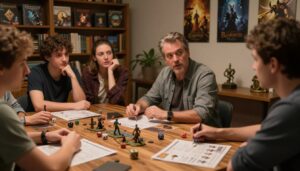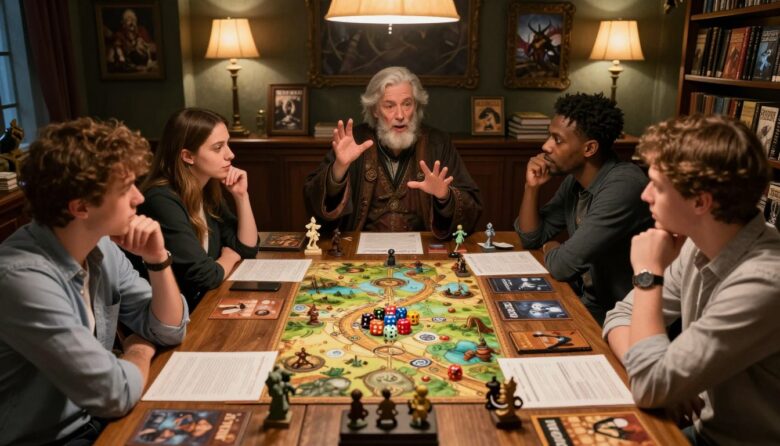
Combat and storytelling are not competing parts of a tabletop RPG. A strong combat scene can reveal loyalties, force difficult choices, and change the direction of the campaign. A conversation can carry as much tension and mechanical weight as a battle.
The real challenge is pacing. Repeated fights can become exhausting, while long stretches of exposition can leave players with little to decide or do. The solution is not a fixed 50/50 split. It is a rhythm suited to the game system, the current story, and the people at the table.
Balance therefore means giving each scene a purpose, varying the kind of pressure players face, and responding when the table’s energy changes.
Start with the Game and the Group
Before adjusting encounter frequency, identify what the rules support and what the players actually enjoy. A campaign becomes harder to manage when its premise promises one experience but its procedures consistently produce another.
Find the system’s center of gravity
Look beyond the game’s setting and examine what its rules make detailed, reliable, and rewarding.
- Resolution: Does the game use a substantial tactical procedure for combat, or resolve all conflicts through the same core mechanic?
- Character abilities: Are most abilities designed for fighting, investigation, relationships, travel, or a broader mixture?
- Rewards: What actions produce advancement, resources, status, or narrative influence?
- Recovery: How costly is violence, and how quickly can characters recover from it?
- GM procedures: Does the game provide encounter-building tools, faction systems, clocks, social rules, or other structures?
Dungeons & Dragons, for example, gives combat substantial mechanical detail and many character abilities designed for use in encounters. Games in the Powered by the Apocalypse tradition generally use moves that connect a character’s action directly to a developing fictional consequence. Blades in the Dark supports scores, faction pressure, downtime, and escalating complications through linked procedures.
None of these approaches prevents a particular kind of story. They do, however, affect preparation and pacing. Running a low-combat political campaign in a combat-focused system may require more interpretation or additional procedures. Adding frequent tactical battles to a rules-light drama game may require the group to accept abstraction rather than detailed positioning.
Ask about specific experiences, not percentages
Asking players whether they want “more combat or more role-playing” can produce misleading answers. Combat is role-playing, and a player may enjoy some fights while disliking others.
More useful Session Zero questions include:
- Do you enjoy tactical planning, fast cinematic action, or both?
- How dangerous should violence feel?
- Do you want opportunities to negotiate with enemies?
- How much time should mysteries, travel, politics, and personal relationships receive?
- Would you rather face a few consequential battles or several smaller encounters?
- Which parts of character creation are you most eager to use?
Revisit these questions during a long campaign. Preferences can change as characters develop, rules become familiar, or a particular storyline runs its course.
Give Every Combat Encounter a Narrative Job
A fight should change something other than hit points and consumable resources. It might expose a secret, alter a relationship, close off an escape route, establish an enemy’s methods, or force the party to choose what matters most.
Before preparing a battle, answer five questions:
- Why is violence happening now?
- What does each side want?
- What happens if the characters do nothing?
- How can the conflict end besides total annihilation?
- What will be different afterward?
If those answers are unclear, the encounter may be unnecessary or may need a stronger connection to the campaign.
Use objectives beyond defeating every opponent
An alternative objective gives players tactical decisions that also carry narrative meaning. Suitable objectives include:
- Protecting a witness until an escape route opens.
- Recovering evidence before a rival destroys it.
- Stopping a ritual without harming its unwilling participants.
- Holding a bridge long enough for civilians to cross.
- Capturing a commander who knows where the prisoners are held.
- Escaping a creature that cannot reasonably be defeated.
Consider a battle in a burning archive. The party needs a stolen ledger, the thieves want to destroy it, and the spreading fire threatens trapped scholars. Attacking enemies, rescuing bystanders, controlling the flames, and finding the ledger all compete for attention. The conflict tells a story because the players cannot accomplish everything with the same action.
Do not overload every encounter with several moving parts. One clear objective and one developing complication are often enough. Excessive timers, environmental effects, reinforcements, and hidden goals can make a scene difficult to understand rather than dramatically rich.
Let opponents act like people
Most enemies have motives beyond fighting to the death. Guards may delay intruders while raising an alarm. Mercenaries may retreat when payment no longer justifies the risk. A frightened creature may attack only until it has a path to escape.
Clear motives create more possible endings: surrender, retreat, negotiation, betrayal, rescue, or pursuit. They also help the GM decide what opponents do without treating every creature as a perfectly coordinated tactical unit.
Morale and surrender should remain consistent with the fiction and the rules. They should not be used merely to cancel a player victory or protect a favored villain.
Make the location matter
A useful battlefield presents visible opportunities and risks. Unstable balconies, ritual circles, moving vehicles, panicked crowds, locked gates, or rising water can affect both tactics and tone.
Describe important features before players commit to a plan. A character should usually be able to see that a rope supports the chandelier or that the floor is collapsing. Concealing every interactive detail until someone guesses the correct action turns environmental play into a test of the GM’s private assumptions.
The setting can also carry information. A ruined manor’s sealed nursery, defaced portraits, and recently used servant passages may reveal more about its history than a separate lore speech would.
Give Non-Combat Scenes Goals and Consequences
Removing combat does not automatically create storytelling. A long conversation without conflict, uncertainty, or meaningful decisions can be as static as an unnecessary battle.
A productive social, investigative, or exploration scene usually needs four elements:
- A goal: What are the characters trying to learn, obtain, prevent, or change?
- An obstacle: Why can they not get it immediately?
- A choice: What approach or sacrifice must they consider?
- A consequence: How does the outcome affect later play?
For example, “the characters speak with the duke” is only a location and activity. “The characters must persuade the duke to release a prisoner before an ambassador arrives, but the duke demands public support for an unpopular law” provides pressure and a decision.
Use mechanics where uncertainty matters
Social scenes should not become uninterrupted GM monologues, but they also do not need a roll after every sentence. Call for a check when the outcome is uncertain, the consequences matter, and the character’s approach could plausibly succeed.
State or signal the stakes when the system expects players to make informed decisions. A failed attempt might cost time, expose an allegiance, worsen an NPC’s attitude, or require a concession. Failure need not end the scene, but it should change the situation.
Respect abilities built for non-combat play. If a character has invested in investigation, diplomacy, survival, or supernatural perception, provide situations where those choices produce useful leverage. Do not nullify an ability simply because it would reveal a prepared secret sooner than expected.
Turn exposition into interaction
Lore is easier to absorb when players can question it, use it, or disagree about it. Instead of delivering a long history of two rival factions, introduce representatives who offer incompatible versions of the same event. Let the characters inspect evidence, consult contacts, or decide whose interpretation serves their goals.
Environmental clues, rumors, letters, customs, and NPC behavior can distribute information across play. The aim is not to hide essential context, but to make learning part of the characters’ activity.
Connect Character History Without Taking Control Away
Backstories can create immediate investment, but only when they remain invitations rather than traps. A missing sibling, former mentor, patron, rival, debt, or inherited object can connect a character to the central conflict.
Discuss major reinterpretations with the player. Turning a beloved relative into a secret villain may sound dramatic, but it can undermine the character concept if imposed without consultation. Useful questions include:
- Which backstory elements are open for the GM to develop?
- Which facts should remain under the player’s control?
- Does the player want reconciliation, tragedy, mystery, or uncertainty?
- How much attention should this personal thread receive?
Avoid making one character’s history the permanent main plot. Rotate personal hooks and connect them where possible. One character’s former commander might work for the faction pursuing another character’s patron, giving both players a stake without collapsing their stories into the same arc.
Build a Rhythm of Pressure and Release
Pacing is not simply alternating one fight with one conversation. Scenes differ in intensity, complexity, and duration. A tense negotiation may be more demanding than a brief ambush, while a relaxed travel scene may give players space to reflect after a major revelation.
A practical session rhythm might include:
- A clear problem or unanswered question.
- Investigation, travel, or negotiation that develops the situation.
- A complication that demands commitment.
- A confrontation, which may or may not become combat.
- A short aftermath in which consequences become visible.
This is a planning aid, not a required structure. Players may avoid the expected confrontation, create a different one, or spend the session pursuing an unexpected lead.
Budget for combat’s real table time
In mechanically detailed games, a battle that lasts less than a minute in the fiction can occupy a large part of a session. Account for that cost when planning. If the climactic encounter needs room to breathe, avoid placing several low-stakes fights before it merely to deplete resources.
When attrition is important to the system, use varied pressures rather than interchangeable battles. Hazards, time limits, difficult routes, negotiations, and resource decisions can contribute to an adventuring challenge, provided the rules and scenario support them.
End scenes when their question has been answered
A scene often begins to drag after its meaningful outcome is already clear. If the enemies are defeated in practice but still have a large pool of hit points, consider whether they would flee, surrender, or change tactics. If the players have obtained all available information from an NPC, summarize the remainder of the conversation and move forward.
This does not mean rushing every quiet moment. Character interaction can be the purpose of a scene. The distinction is whether players are still making discoveries and choices or merely repeating established points.
Diagnose Pacing Problems at the Table
| What you observe | Possible cause | Adjustment to try |
|---|---|---|
| Combat continues after the outcome feels certain | Opponents lack motives, morale, or changing objectives | Use retreat, surrender, reinforcements, or a new objective when justified by the fiction |
| A social scene circles the same topic | No deadline, demand, or decision is moving it forward | Have the NPC make a concrete offer, impose a cost, or end the meeting |
| Players attack before negotiating | Violence appears faster or more reliable than every alternative | Make nonviolent approaches actionable and show the likely consequences of escalation |
| Players avoid every fight | Combat may feel too punishing, slow, repetitive, or disconnected | Ask which problem is dominant, then adjust danger, frequency, complexity, or purpose |
| One player dominates most scenes | Spotlight is being distributed by confidence rather than relevance | Invite another character’s expertise and create moments that require different abilities |
| Players seem lost after a reveal | Essential information was unclear or buried in exposition | Restate confirmed facts, distinguish clues from assumptions, and offer clear leads |
These symptoms are not proof of a single problem. A tired player may be quiet for reasons unrelated to the game. Treat observations as reasons to check in, not as permission to diagnose someone’s preferences without asking.
Adapt Without Invalidating Player Choices
Prepared material should support play rather than dictate it. If the party negotiates with an expected enemy, the GM can shift attention from battle statistics to motives, leverage, and consequences. If they bypass a carefully designed location, useful elements may be saved for later rather than forced back into the session.
Adaptation has limits. Secretly increasing every enemy’s durability because the players built effective characters makes their choices feel meaningless. Moving every clue behind whichever door they open can make investigation feel cosmetic. Adjust presentation and pacing when necessary, but preserve established facts and earned advantages.
When energy drops, choose the smallest effective intervention:
- Summarize routine travel or repeated discussion.
- Restate the immediate problem and available options.
- Introduce a consequence already implied by the situation.
- Call for a short break.
- Ask directly whether the group wants to continue the scene.
A break is often more useful than an artificial ambush. Not every lull needs an in-fiction complication.
Make Feedback Specific and Actionable
General questions such as “Did everyone have fun?” tend to produce polite but limited answers. Ask about individual parts of the session:
- Did the final battle feel tense or simply long?
- Was the villain’s objective clear?
- Did the negotiation offer enough room for different approaches?
- Which scene would you have shortened?
- Which unresolved thread do you most want to pursue?
Different players may give conflicting answers. The GM does not need to implement every request. Look for patterns, discuss tradeoffs, and make small adjustments that can be evaluated after another session.
How Players Can Support the Balance
Session pacing is a shared responsibility. Players can help by learning the rules most relevant to their characters, deciding on actions promptly when possible, and remaining engaged with scenes that spotlight someone else.
They can also create connections between action and story:
- Explain what a tactical choice reveals about the character’s priorities.
- Ask allies for opinions rather than making every decision alone.
- Pursue clues and relationships instead of waiting for the GM to deliver a plot.
- Accept complications that fit the character without deliberately obstructing the group.
- Give concise feedback about which encounters and decisions were engaging.
Sharing the spotlight does not require silence. A player can bring another character into a scene by requesting their expertise, referring to their history, or asking how they respond to a difficult choice.
Common Balancing Mistakes
Treating combat as the default consequence
If every failed negotiation produces a fight, social choices become a prelude to combat rather than a meaningful mode of play. Use a wider range of consequences: lost trust, debt, delay, public embarrassment, political concessions, or an enemy gaining leverage.
Using random encounters without a clear function
Random encounters can establish danger, create resource pressure, or make travel unpredictable. They become filler when they neither demand an interesting decision nor affect what follows. Interpret or modify a result so that it connects to the location, factions, or current objective.
Protecting the planned plot from player success
If clever tactics defeat a major threat early, let that success matter. The campaign can explore the resulting power vacuum, retaliation, or unexpected opportunity. Replacing the defeated enemy with an identical obstacle teaches players that outcomes are predetermined.
Confusing complexity with significance
More phases, abilities, lore, and hidden mechanics do not necessarily create a better climax. A simple conflict with a difficult choice can carry more weight than an elaborate encounter whose objectives are unclear.
Giving every session the same shape
A predictable sequence of investigation, minor fight, rest, and boss battle eventually loses force. Vary scale and structure. One session might revolve around a single siege, another around a trial, and another around the consequences of a choice made several sessions earlier.
Balance Is a Continuing Conversation
There is no universally correct ratio of combat to storytelling. The useful measure is whether scenes provide meaningful participation, reflect the game’s strengths, and leave the campaign changed.
Design fights around motives and objectives. Give conversations obstacles and consequences. Allow quiet scenes after sustained pressure, and shorten encounters whose dramatic question has already been resolved. Most importantly, ask the group what is working and adjust without erasing their choices.
When combat advances the story and story decisions reshape later conflicts, the division between the two largely disappears. What remains is a campaign with a varied, responsive rhythm—and a table that has reasons to care about what happens next.

Ravenous RPG Editorial Team covers tabletop role-playing games, Game Master tools, player guides, campaign design, character building, and RPG system analysis. Articles are edited for clarity, practical usefulness, and accuracy, and are updated when corrections or material changes are needed.